Quote Request
Quote
Manufacturers and Suppliers of Charpy Impact Tester / Izod Impact Tester

VSP / HDT Apparatus — Vicat Softening Point & Heat Deflection Temperature Tester Manufacturer in India

About Computerised VSP / HDT Apparatus (Vicat Softening Point apparatus / Heat deflection Test apparatus)

As per ASTM D - 1525 and ASTM D - 648 as well as ISO 306 and ISO 75 to determine vicat softening temperature and heat deflection temperature (heat distortion temperature) of polymers, compounds and engineering plastics.

International Equipments is a leading manufacturer, supplier and exporter of VSP / HDT Apparatus (Vicat Softening Point and Heat Deflection Temperature testing equipment) in India. Built at our Mumbai facility, our VSP / HDT Apparatus is a precision instrument that measures the two key thermal-property characteristics that together define the maximum service temperature of any thermoplastic material - Vicat Softening Point per ASTM D 1525 / ISO 306, and Heat Deflection Temperature per ASTM D 648 / ISO 75. Available in two variants - Computerised (2 or 6 stations) and Analogue (2 stations) - to suit different laboratory budgets and testing volumes.

Vicat Softening Point (VSP) and Heat Deflection Temperature (HDT, also called Heat Distortion Temperature) are the two most-referenced thermal properties on every polymer datasheet - they directly tell the engineer the maximum temperature at which a finished plastic part can perform its function without significant deformation. They are essential for material selection in automotive components, electrical and electronic housings, hot-water plumbing pipes (CPVC, PPR), engineering plastic parts, glass-filled composites and any application where the part will see elevated service temperature.

★ CLIENT USING THIS MODEL (Computerised)
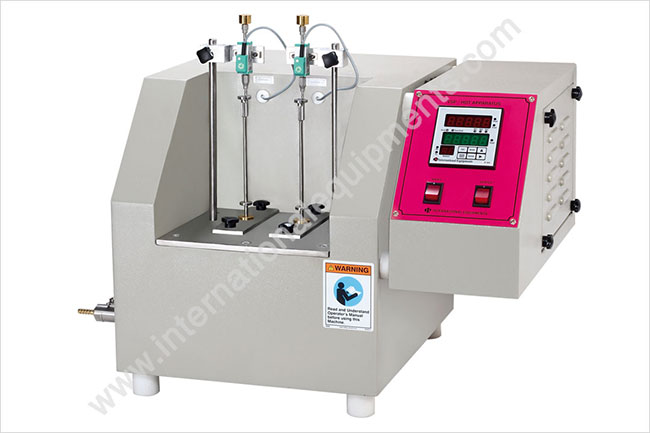
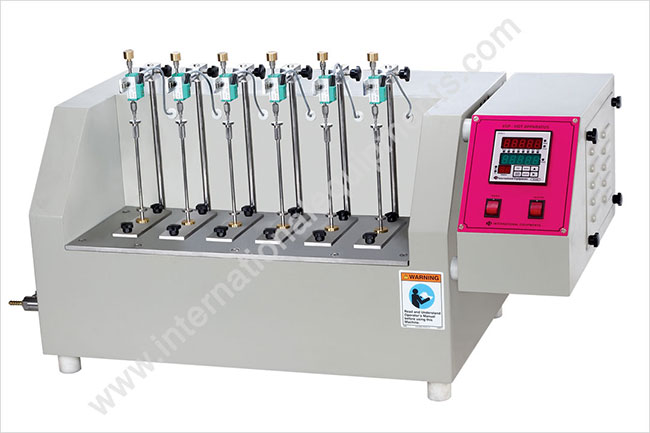
Computerised VSP / HDT Apparatus manufacturers
6 Stations Computerised VSP / HDT Apparatus

Computerised Variant — Specifications

ParameterSpecification
Temperature RangeFrom ambient to 300°C
Number of StationsWith options of 2 stations to 6 stations
Material of ConstructionInner bath: S.S; Outer body: M.S
Rate of Heating120°C / hour and 50°C / hour
SensorRange up to 10 mm with resolution of 0.01 mm
PaintPowder coated
Power230 Volts, 50 Hz, single phase
WeightsSet of weights ranging from 5 grams to 2000 grams for incremental loads
Direct Display through MicrocontrollerVSP and HDT result
Graphic Display & Printout through PCPenetration/Deflection vs Temperature graph and numeric reports via attached printer

* Specifications kept exactly as published on the existing website.

Analogue VSP / HDT apparatus

As per ASTM D - 1525 and ASTM D - 648 as well as ISO 306 & ISO 75 to determine vicat softening temperature and heat deflection temperature of polymers, compounds & engineering plastics.
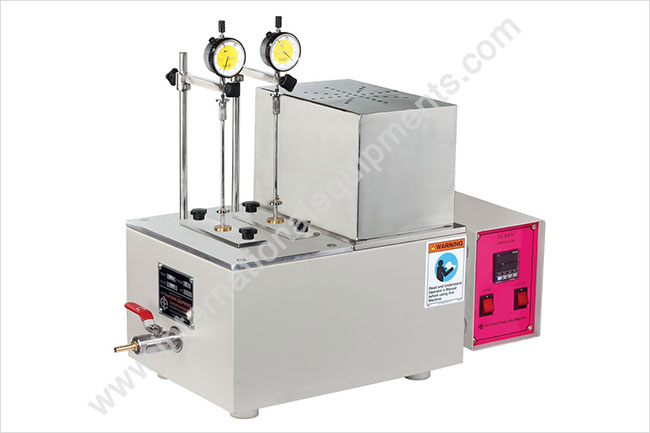
Analogue VSP / HDT apparatus
Temperature RangeFrom ambient to 300°C
No. of StationsTwo
Material of ConstructionInner bath: S.S; Outer body: M.S
Rate of Heating120°C / hour and 50°C / hour
Dial GaugeRange up to 10 mm, resolution 0.01 mm
PaintPowder coated
Power230 Volts, 50Hz, single phase
Weights5 grams to 2000 grams for incremental loads
★ CLIENT USING THIS MODEL (Analogue)

What is a VSP / HDT Apparatus?

A VSP / HDT Apparatus is a precision thermal-property testing instrument that determines the temperature at which a polymer specimen softens or deflects under a defined applied load - simulating, in a controlled laboratory environment, the heat-resistance failure mode a finished plastic part might experience in service. The instrument consists of a temperature-controlled oil bath, multiple test stations each holding a specimen under a calibrated weight, precision penetration/deflection sensors, and a programmable temperature ramp.

Two different test methods are performed on the same instrument - Vicat Softening Point (VSP) measures the temperature at which a flat-ended indenter penetrates 1 mm into the polymer surface; HDT measures the temperature at which a polymer bar specimen, loaded as a 3-point beam, deflects by a specified amount.

About Our VSP / HDT Apparatus Range

Our VSP / HDT Apparatus is purpose-built for the ASTM D 1525 / D 648 and ISO 306 / 75 test methods - not a generic heating bath adapted for the purpose. Stainless-steel inner bath ensures corrosion-free service; mild-steel powder-coated outer body for long service life. Programmable temperature ramp at either 50°C/hour or 120°C/hour covers the slow and fast ramp rates specified by the standards.

Multi-station design lets the laboratory test multiple specimens simultaneously. Our Computerised variant comes in 2-station and 6-station configurations; the Analogue variant comes in a 2-station configuration. Precision penetration/deflection sensor - range up to 10 mm with resolution of 0.01 mm - captures the specimen's dimensional response with the precision valid VSP and HDT results require. The standard supply includes a calibrated weight set from 5 grams to 2000 grams.

The Computerised variant is built with a dedicated microcontroller, digital penetration/deflection sensor, and PC connectivity for full data logging and printable reports. The Analogue variant uses a precision analogue dial gauge instead, well-suited for educational institutions and budget-constrained labs.
Why VSP & HDT Testing is Critical

  • Defines the Maximum Service Temperature
    VSP and HDT together tell the engineer the highest temperature at which a finished plastic part can perform without significant deformation.
  • Essential for Engineering Plastic Grade Qualification
    Engineering plastics (ABS, PC, PA, POM, SAN) are selected and specified largely on thermal performance.
  • Critical for Glass-Filled & Reinforced Composites
    Glass fibre reinforcement dramatically elevates HDT, often by 50°C or more above the base polymer.
  • Required for CPVC / PPR Hot-Water Pipe Specification
    The Vicat softening point of the compound is a key specification parameter for hot-water plumbing pipes.
  • Catches Compound Drift in Master-Batch and Recycled Polymers
    Routine VSP / HDT testing catches formulation drift before bad compound reaches the customer.

How the VSP and HDT Tests Work

  • Step 1 - Prepare the Polymer Specimen
    Cut the specimen to the dimensions specified by the standard, usually from injection-moulded plaques using the Hydraulic Press and dies.
  • Step 2 - Mount Specimens and Apply the Calibrated Weight
    For VSP, a flat-tip indenter rests on the surface; for HDT, the specimen rests as a 3-point beam. Apply the calibrated weight per the standard.
  • Step 3 - Start the Temperature Ramp
    Select the heating rate (50°C/hour or 120°C/hour) and start the ramp from ambient.
  • Step 4 - Record the Penetration / Deflection as Temperature Rises
    The Computerised variant captures the full curve continuously; the Analogue variant lets the operator monitor the dial gauge.
  • Step 5 - Determine the VSP / HDT Temperature
    For VSP, the temperature at 1 mm penetration; for HDT, the temperature at the standard's defined deflection amount.

VSP vs HDT - What is the Difference?

  • Vicat Softening Point (VSP) - ASTM D 1525 / ISO 306
    Measures the temperature at which a flat-tipped 1 mm² indenter, under a fixed load (10N Method A or 50N Method B), penetrates 1 mm into the specimen's top surface.
  • Heat Deflection Temperature (HDT) - ASTM D 648 / ISO 75
    Measures the temperature at which a beam specimen, loaded at a specified fibre stress (commonly 0.45 MPa or 1.82 MPa), deflects by a specified amount.
  • Which Test to Use - Practical Guide
    Both tests are usually run on the same polymer. VSP is faster and more sensitive to surface softening; HDT correlates better with structural performance under load. Our apparatus performs both on the same instrument.

Technical Information

  • ASTM D 1525 - Standard Test Method for Vicat Softening Temperature of Plastics
  • ASTM D 648 - Standard Test Method for Deflection Temperature of Plastics Under Flexural Load
  • ISO 306 - Plastics: Thermoplastic Materials - Determination of Vicat Softening Temperature
  • ISO 75-1 / ISO 75-2 - Plastics: Determination of Temperature of Deflection Under Load
  • IS 6307 - Vicat softening temperature of thermoplastic materials
  • IS 11521 - Heat deflection temperature
  • IS 13360 - Indian Standard methods of test for plastics
  • BS 2782 Method 121A - Vicat softening point (UK standard)
  • DIN 53460 / DIN 53461 - German standards for Vicat and heat distortion temperature
  • Vicat Softening Point of HDPE, LDPE, LLDPE, MDPE per ASTM D 1525 / ISO 306
  • Vicat Softening Point of polypropylene (PP, PPR) for hot-water pipe specification
  • Vicat Softening Point of rigid uPVC and CPVC for plumbing pipe specification
  • Vicat Softening Point of PS, ABS, SAN and glass-filled nylon composites
  • Heat Deflection Temperature of polycarbonate (PC) and PC blends per ASTM D 648 / ISO 75
  • Heat Deflection Temperature of glass-filled and fibre-reinforced composites
  • Heat Deflection Temperature of automotive under-hood polymer components
  • Thermal performance verification of master-batch and compounded grades
  • Material selection for hot-fill packaging, electrical and automotive components
  • Polymer R&D and new grade qualification
  • Polymer Producers & Petrochemical Companies
  • Master-batch & Compound Manufacturers
  • Engineering Plastic Moulders (ABS, PC, PA, POM, SAN)
  • Glass-Filled & Composite Component Manufacturers
  • Automotive Component Manufacturers
  • CPVC Hot-Water Pipe Manufacturers (IS 15778)
  • PPR Hot-Water Pipe Manufacturers (IS 15801)
  • uPVC Pipe & Profile Manufacturers
  • Government Testing Labs, NABL Accredited Labs & BIS-Approved Test Houses
  • R&D Centres of Polymer, Plastic and Automotive Companies
  • Two Variants - Computerised & Analogue
    Choose the variant that fits your laboratory and budget - both follow the same ASTM/ISO test methods.
  • Multi-Station Capability (2, 3, 4 and 6 Stations)
    Test multiple specimens simultaneously for productive QC labs and R&D centres.
  • Full ASTM and ISO Standard Coverage
    VSP per ASTM D 1525 AND ISO 306; HDT per ASTM D 648 AND ISO 75 - one instrument covers all four standards.
  • Selectable Heating Rate (50°C/hour or 120°C/hour)
    Both standard heating rates supported - no need for separate slow-ramp and fast-ramp instruments.
  • Wide Weight Set (5 g to 2000 g)
    Covers VSP Methods A and B, plus the HDT fibre-stress range.
  • PC Software with Graph and Report Output
    Computerised variant gives live penetration-vs-temperature graphing and printable reports.
  • ISO Certified, CE Marked Manufacturing
    Built at our Mumbai facility under ISO certified quality systems, CE marked for export.
  • Free Installation, Training & Calibration
    Free on-site commissioning, operator training on both VSP and HDT test methods, and calibration certificates.

FAQs

Both measure heat resistance but in different ways. VSP (ASTM D 1525 / ISO 306) measures the temperature at which a flat-tipped 1 mm² indenter penetrates 1 mm into the polymer surface under a fixed load. HDT (ASTM D 648 / ISO 75) measures the temperature at which a beam specimen deflects by a specified amount under 3-point bending. Our apparatus performs both tests on the same instrument.
It depends on your testing volume. The 2-station variant suits smaller QC labs doing occasional testing. The 6-station variant suits polymer producers and R&D centres that routinely screen multiple grades simultaneously - it is also more economical per test if throughput is high.
Choose the Computerised variant if you need documented graphs, printable reports for NABL accreditation, or multi-station capability beyond 2 stations. Choose the Analogue variant if you do only occasional testing, budget is the primary constraint, or you are an educational institution.
Both are Vicat Softening Point methods specified by ASTM D 1525, differing only in the load applied to the indenter. Method A uses a 10N load for soft/flexible polymers; Method B uses a 50N load for harder/stiffer polymers. Method B value is always higher when both are reported.
Different test standards specify different heating rates depending on the polymer and test variant. ASTM D 1525 specifies 50 or 120°C/hour for Vicat; ASTM D 648 specifies 120°C/hour for HDT. Both rates are provided as selectable options on our instrument.
Yes - the live VSP / HDT Apparatus page already embeds a YouTube product video demonstrating the Computerised variant in operation. We can also share client-reference PDFs for both variants on request.
Yes - glass-filled and fibre-reinforced composites are among the most important applications for HDT testing, since glass fibre reinforcement can elevate HDT by 50°C or more above the base polymer. Our apparatus handles the higher-HDT temperatures common in these grades.
Yes. Free on-line commissioning, operator training on both the VSP and HDT test methods, and factory calibration certificate for the temperature controller and the weight set.

Need a reliable VSP / HDT Apparatus for polymer grade qualification or hot-water pipe testing?

Contact International Equipments today for a personalised quotation. Tell us your polymer types, expected testing volume, station-count requirement (2 or 6), and variant preference (Computerised or Analogue) and the test standards you follow (ASTM D 1525 / D 648, ISO 306 / 75) - our team will share pricing, delivery timeline and the list of leading polymer producers, engineering plastic moulders and R&D institutions already using our VSP / HDT Apparatus.

Get Free Quote