Request
Quote

As per IS 4984 and IS 4985.
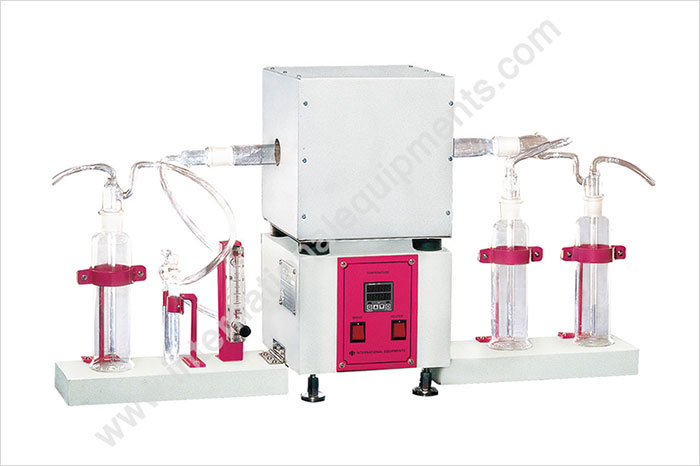
International Equipments is a leading manufacturer, supplier and exporter of Carbon Black Dispersion Test Apparatus in India. Built at our Mumbai facility, our Carbon Black Dispersion Tester is a precision microscope-based instrument that grades the dispersion quality - the uniformity of carbon black distribution - in HDPE pipe, PE gas pipe and PLB duct compounds, strictly as per IS 4984, IS 4985 and the related ISO 18553 international standard.
Carbon black dispersion is the natural companion test to Carbon Black Content. While the Content Apparatus measures HOW MUCH carbon black is in the polymer, the Dispersion Tester measures HOW WELL DISTRIBUTED it is throughout the polymer matrix. Even with the correct 2.0-2.5% loading, poorly-dispersed carbon black forms visible agglomerates that act as stress concentration points in the pipe wall - causing premature brittle failure in service. Both tests are mandatory under IS 4984, IS 4985 and the DOT specification for HDPE PLB duct, and most HDPE pipe QC laboratories purchase the matched pair from a single supplier.
★ CLIENT USING THIS MODEL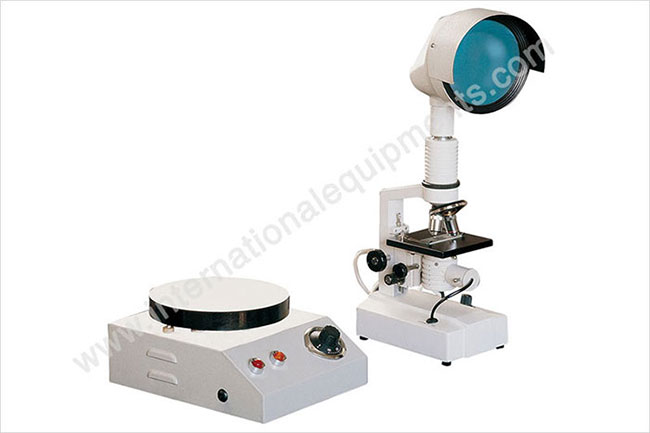
Carbon Black Dispersion Testing is a microstructural quality test that evaluates how uniformly the carbon black pigment is distributed throughout the polyethylene matrix of HDPE pipe material. A thin sample of the polymer is prepared on a hot plate (which softens the polymer to a controlled film thickness), then examined under a calibrated microscope. The operator counts and sizes the visible carbon black agglomerates - undispersed clumps of carbon black that have not been broken down to the individual particle level during compounding. The dispersion is then graded against reference images on a 1-to-6 grade scale per ISO 18553.
Good dispersion means the carbon black is broken down to its fundamental particle size (typically 20-50 nanometres) and uniformly distributed throughout the polymer - invisible to the naked eye, appearing as a uniform black mass under the microscope. Poor dispersion means the carbon black is still present as larger agglomerates - each agglomerate is a stress concentration point that fails earlier than the surrounding polymer matrix.
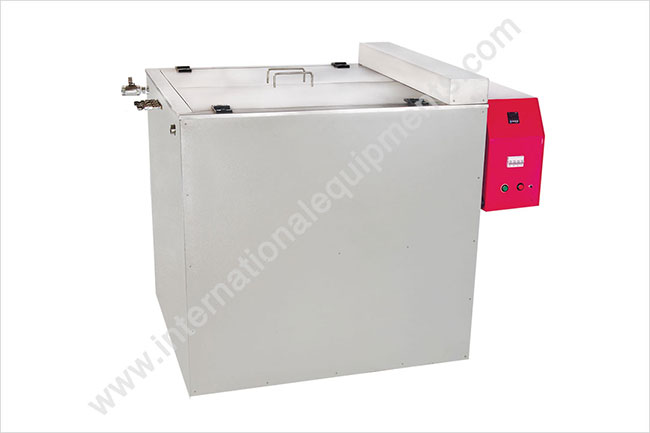
Our Carbon Black Dispersion Test Apparatus integrates two essential components into a single bench-top unit: (1) an 8 inch diameter hot plate for sample preparation, with controlled temperature from ambient to 200°C; and (2) a calibrated microscope with 6 inch diameter viewing screen at two magnifications - 100X for general dispersion grading and 450X for higher-resolution evaluation of fine agglomerates.
The hot plate is the sample-preparation stage. A small pellet or strip of HDPE compound is placed between two glass slides on the hot plate; the heat softens the polymer to a precise thickness (typically around 20-100 microns) suitable for transmitted-light microscope examination. Temperature up to 200°C comfortably covers all the common polyethylene grades used in HDPE pipe (melting around 130°C) and higher-melting grades used for PLB telecom duct.
The microscope side has a 6-inch screen that gives a clear, magnified view of the prepared sample - large enough for the operator to count and grade dispersed carbon black agglomerates against the ISO 18553 reference standard images. Robust M.S. construction with powder-coated finish, standard 230 V / 50 Hz single-phase operation - built for daily QC use in busy HDPE pipe manufacturing plants.
Contact International Equipments today for a personalised quotation. Tell us your pipe type and the test standards you follow (IS 4984, IS 4985, IS 14930, ISO 18553, DOT specification) - our team will share pricing, delivery timeline and the matched Carbon Black Content + Carbon Black Dispersion package option for the complete carbon-black QC requirement.
Get Free Quote