Quote Request
Quote
Manufacturers and Suppliers of Charpy Impact Tester / Izod Impact Tester

Laboratory Heat Sealer — Sealing Parameter Tester Manufacturer in India

About Laboratory Heat Sealer — Manufacturer in India

To Determine Suitable Sealing Parameters Of Films — sealing temperature, sealing time and sealing pressure — of plastic films, flexible packaging laminates and multilayer pouches under controlled, repeatable laboratory conditions.

International Equipments is a leading manufacturer, supplier and exporter of Laboratory Heat Sealers in India. Built at our Mumbai facility, our Heat Sealer is a precision table-top instrument used to determine the optimum heat-sealing parameters of plastic films, flexible packaging laminates and multilayer pouches.

Selecting the right sealing parameters is critical for any flexible packaging product. Set the temperature too low and the seal fails; too high and the film burns, melts through or weakens around the seal. Our Heat Sealer gives the film, laminate or pouch developer a repeatable way to evaluate every combination of temperature, dwell time and pressure — producing test seals that are then peel-tested to find the parameter window that gives consistently strong, leak-tight, attractive seams on the production sealing machine.

★ CLIENT USING THIS MODEL
Manufacturers and Suppliers of Heat Sealer

Specifications Table

Parameter Specification
Temperature Zone Two.
Controller Auto tuned PID controller with temperature range up to 200°C having resolution of 0.1°C.
Clamping Jaws One fixed and second movable by pneumatic action.
Speed 300 mm/minute.
Day Light 50 mm.
Sealing Dimensions Length 150 mm x Width 20 mm.
Mounting Table top.
Power Requirement 230 Volts, 60 Hz, Single phase - 15 ampere.

* Specifications kept exactly as published on the existing website.

What is a Laboratory Heat Sealer?

A Laboratory Heat Sealer — also called a Lab Heat Sealer, Bar Sealer, Sealing Tester or Pouch Sealer — is a small bench-top instrument that creates controlled heat-sealed test specimens from plastic film, multilayer laminate or pouch material. Two heated sealing jaws (typically one fixed and one moving) come together onto the film with precisely controlled temperature, pressure (from a pneumatic cylinder) and dwell time. The result is a uniform, repeatable seal — exactly the kind needed to study and optimise sealing parameters before committing to a production-machine setting.

Unlike a production-floor heat sealer (where the sealing parameters are usually fixed by mechanical hardware and difficult to vary), the laboratory Heat Sealer lets the developer or QC engineer dial in any combination of temperature (up to 200°C with 0.1°C resolution in our model) and dwell time. The resulting test seals are then peeled apart on a Peel Tester to determine which parameter window delivers the target seal strength. This evidence-based approach is the standard methodology in every well-equipped flexible packaging R&D and QC lab.

About Our Laboratory Heat Sealer

Our Laboratory Heat Sealer is built around two independent temperature zones (one for each jaw — upper and lower) with auto-tuned PID controllers covering ambient to 200°C at 0.1°C resolution. Independent control of upper and lower jaw temperatures is essential when working with multilayer laminates where one side may need a different temperature than the other — for example, an aluminium-foil-backed laminate where the foil side conducts heat faster than the film side.

The sealing action is pneumatic — one fixed jaw and one movable jaw closing under controlled air pressure. Pneumatic actuation (rather than spring or manual lever closure) gives consistent, repeatable sealing pressure on every test seal, which is critical for parameter-window studies. The standard sealing area is 150 mm × 20 mm — wide enough to cut multiple peel-test strips from a single seal, and long enough to mimic the seam geometry of typical pouch and sachet packaging.

Table-top mounting and a 50 mm daylight (the open space between the jaws) make the instrument fast and easy to load — even thick laminate samples slip in without effort. The 230 V single-phase 15-ampere power supply makes the Heat Sealer compatible with any standard Indian or export laboratory power point.

Why Determining Sealing Parameters Matters

  • Each Film Has Its Own Sealing Window
    LDPE film, BOPP, polyester-PE laminate, foil-PE-PET pouch material — every film and laminate has its own optimum temperature, time and pressure window, influenced by thickness, sealant composition, additives, printing/coating and humidity.
  • Catches Sealing Problems Before Production
    Doing the parameter study on the lab Heat Sealer (maybe 50 test seals) catches sealing problems while they cost only operator time — the production line catches them only after wasting material, machine hours and customer confidence.
  • Validates New Film and Laminate Grades
    When a film supplier sends a new grade, or a compounder reformulates a multilayer structure, lab heat-sealing is the first test before approving the new material for production.
  • Required by Food, Pharma & Retort Pouch Specs
    ASTM F 88 (Seal Strength of Flexible Barrier Materials) and related ISO/IS standards reference a lab-grade heat sealer + peel-tester workflow as the documentation of seal-strength validation.
  • Optimises Sealing Speed on the Production Line
    The lab study identifies the minimum dwell time that still gives an acceptable seal strength — letting production engineers safely run faster without sacrificing seal quality.

How the Heat Sealer is Used in the Lab

  • Step 1 — Make a Matrix of Test Seals
    Set the temperature to a starting value (e.g., 120°C). Make a test seal at 0.5 seconds dwell, then 1, 1.5 and 2 seconds. Step the temperature up by 10°C and repeat — building a matrix across the full parameter space (typically 10–30 test seals).
  • Step 2 — Cut Peel Specimens
    Using a sharp blade or specimen cutter, cut a 25 mm wide strip across each test seal. Each strip is one peel-test specimen — labelled with the temperature and dwell time it was sealed at.
  • Step 3 — Peel Each Strip (ASTM F 88)
    Load each strip in the Peel Tester at the standard 300 mm/minute speed. The Peel Tester records the peel force — directly indicating seal strength for that combination of temperature and dwell time.
  • Step 4 — Identify the Optimum Sealing Window
    Plot the seal-strength results on a temperature-vs-time chart. The area where seal strength meets the target (often a minimum N/25 mm value) is the parameter window for production.

Heat Sealer + Peel Tester — The Complete Seal-Strength Workflow

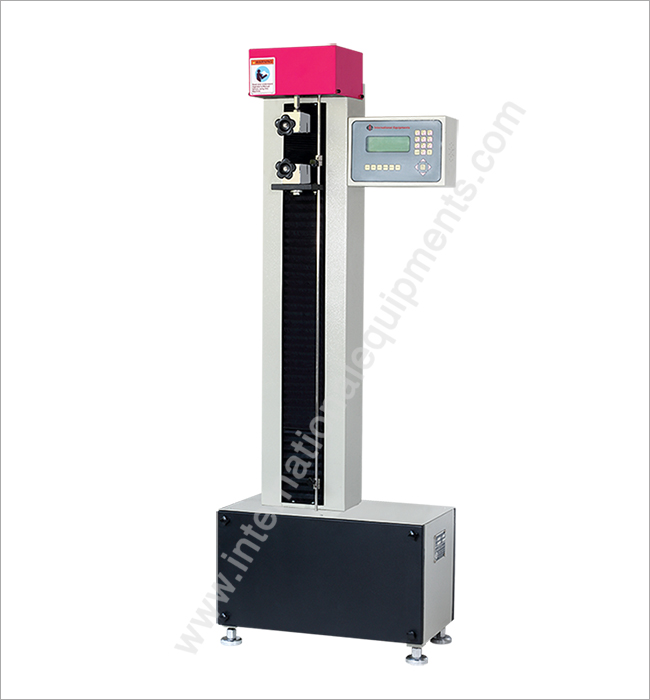
The Heat Sealer is purpose-designed to work hand-in-hand with the Digital Peel Tester. Together they form the standard ASTM F 88 seal-strength testing workflow used in the flexible packaging industry — the Heat Sealer creates controlled, repeatable test seals at any combination of temperature and dwell time, and the Peel Tester (or our Tensile Testing Machine for higher loads) measures the peel force needed to open those seals.

The matched pair gives you a complete sealing-parameter optimisation laboratory, with consistent dimensional compatibility between the test seal and the peel-test specimen. Most flexible packaging QC labs and R&D centres invest in both instruments together. We commonly supply the matched set as a package quotation with a single commissioning visit — please mention this in your enquiry.
Technical Information

  • ASTM F 88 — Standard Test Method for Seal Strength of Flexible Barrier Materials (the parent standard for heat-seal validation)
  • ASTM F 1140 — Standard Test Methods for Internal Pressurization Failure Resistance of Unrestrained Packages (uses lab-sealed pouches)
  • ASTM F 2096 — Standard Test Method for Detecting Gross Leaks in Packaging by Internal Pressurization (Bubble Test)
  • ISO 11607 — Packaging for Terminally Sterilized Medical Devices (referenced for medical-pouch seal validation)
  • ISO 23656 — Quantitative test method for the evaluation of seal strength of flexible barrier materials
  • ASTM D 3078 — Standard Test Method for Determination of Leaks in Flexible Packaging by Bubble Emission
  • Optimisation of sealing temperature, time and pressure parameters for plastic films
  • Heat-seal qualification of multilayer flexible packaging laminates
  • Production of test seals for ASTM F 88 peel-strength testing on a Peel Tester
  • Evaluation of new film grades, sealant layers and master-batches
  • R&D of retort-pouch and high-barrier laminates for food and pharmaceutical packaging
  • Seal-window mapping for snack-food, ready-to-eat and confectionery packaging
  • Validation of medical-pouch seals per ISO 11607 (with Peel Tester)
  • Heat-seal QC of milk pouches, sachets, lamitubes and stand-up pouches
  • Sealing-parameter studies for coated paper and paper-based laminate packaging
  • Testing the effect of slip agents, anti-block agents and printing inks on seal performance
  • Training laboratory for polymer engineering and packaging technology courses
  • Flexible Packaging & Multilayer Laminate Producers
  • Food, Snack & Confectionery Packaging Industry
  • Pharmaceutical & Medical-Pouch Packaging Industry
  • Retort Pouch & Ready-to-Eat Food Packaging Industry
  • Lamitube & Dairy Packaging Manufacturers
  • Milk Pouch & Stand-up Pouch Converters
  • Sachet, Strip & Blister Packaging Manufacturers
  • Plastic Film & BOPP Film Producers
  • Polymer Master-batch & Sealant Compounders
  • Printing & Packaging Converters
  • Government Testing Labs, NABL Labs & Universities
  • Packaging R&D Centres
  • Two Independent Temperature Zones
    Upper and lower jaws have separate PID-controlled temperatures — essential for asymmetric laminates (foil-backed pouches, multilayer structures with different conducting layers).
  • Auto-Tuned PID at 0.1°C Resolution
    Auto-tuned PID controllers give tight, stable temperature control up to 200°C — covering virtually every sealable film and laminate formulation.
  • Pneumatic Jaw Closure for Repeatable Pressure
    Pneumatic actuation gives consistent sealing pressure on every test seal — essential for parameter-window studies where small variations matter.
  • 150 × 20 mm Sealing Area
    Wide enough to cut multiple 25 mm peel-test strips from a single seal, long enough to mimic the seam geometry of typical sachets, snack bags and lamitubes.
  • Designed to Pair with Our Peel Tester
    Specifically dimensioned for the ASTM F 88 workflow — make test seals on the Heat Sealer, cut strips, peel on our Digital Peel Tester. Matched pair available as a package quotation.
  • Compact Bench-Top Footprint
    Fits easily on any standard lab bench alongside the Peel Tester, MFI Tester or other film/packaging QC instruments.
  • ISO & CE Certified Manufacturing
    Designed and built at our Mumbai facility under ISO certified quality systems, with CE marking for export to the Middle East, Africa, South-East Asia, Europe and South America.
  • Free Installation, Training & Calibration
    Free on-site commissioning, operator training on the parameter-window study methodology and a factory calibration certificate at the customer's location anywhere in India. AMC available for long-term support.

FAQs

A production heat sealer is built for high-speed continuous sealing of long film runs on a packaging line — sealing parameters are usually fixed by mechanical hardware and difficult to vary. A laboratory Heat Sealer is built for parameter studies — temperature, dwell time and pressure are fully adjustable, sealing area is small and standardised, and the sealed result is meant to be peel-tested for strength evaluation. The lab Heat Sealer is for development and QC; the production sealer is for actual product manufacture. Both have their place, but you cannot reliably substitute one for the other.
Two independent zones (one for the upper jaw, one for the lower) are essential when working with asymmetric multilayer laminates — for example, an aluminium-foil-backed pouch where the foil side conducts heat much faster than the polymer-film side. With a single-zone Heat Sealer, getting the right sealing temperature at the polymer interface means either over-heating the foil side or under-heating the polymer side. With two independent zones, you can set different temperatures for each jaw and optimise the seal exactly. Two-zone control is the industry-standard configuration for any serious flexible-packaging lab.
Sealing temperatures typically range from 80°C (low-temperature sealable LDPE coatings) to 180°C or higher (PET-based retort-pouch laminates). Sealing dwell times typically range from 0.3 seconds (high-speed snack-food laminates) to 3 seconds (heavy retort pouches). Sealing pressure varies by application but is generally in the 0.2 to 0.5 MPa range. Our Heat Sealer covers all these ranges comfortably.
The test seals are not the end of the test — they are the input. After sealing, the operator cuts 25 mm wide strips across each test seal and pulls them apart on a Peel Tester (or a Tensile Testing Machine) at 300 mm/minute as per ASTM F 88. The peel force directly indicates the seal strength achieved by that combination of temperature and dwell time. Plotting all the results gives the sealing-parameter window for that film. This Heat Sealer + Peel Tester workflow is the standard ASTM F 88 methodology.
Yes, within its 150 × 20 mm sealing area. The Heat Sealer is ideal for making small test pouches that can be filled, sealed and then used in burst tests, drop tests, leak tests and shelf-life tests. Many R&D labs use the Heat Sealer specifically for creating prototype small-batch pouches before committing to a production run. For larger pouch dimensions, a different sealing configuration would be needed — please discuss specialised requirements in your enquiry.
The specification on the existing site lists 60 Hz. India typically operates on 50 Hz; most of our equipment is designed for 50/60 Hz dual frequency operation to support both Indian and export markets. Please confirm your local power frequency in your enquiry — the Heat Sealer will be configured to match your grid frequency at the manufacturing stage.
Yes. The Laboratory Heat Sealer and our Digital Peel Tester are the two instruments that together implement the ASTM F 88 seal-strength workflow. We commonly supply the matched pair as a single package quotation with one commissioning visit and one training programme covering both methods. Please ask for the package quotation in your enquiry.
Yes. We provide free on-site installation, commissioning, operator training (including the four-step parameter-window study methodology) and a factory calibration certificate for the PID temperature controllers at the customer's location anywhere in India. Because heat-sealing is as much methodology as it is hardware, we put extra emphasis on the operator training during commissioning. We offer a calibration visit on a yearly basis on completion of 1 year at additional cost.

Need a reliable Laboratory Heat Sealer for your laboratory?

Contact International Equipments today for a personalised quotation. Tell us your film type (single-layer film, multilayer laminate, foil-backed pouch) and the test standard you follow (ASTM F 88, ISO 11607) — our team will share pricing, delivery timeline, and the matched Heat Sealer + Peel Tester package option for the complete ASTM F 88 seal-strength workflow.

Get Free Quote