Quote Request
Quote
Manufacturers and Suppliers of Charpy Impact Tester / Izod Impact Tester

Digital Zero Degree Chamber — Pipe Conditioning Chamber Manufacturer in India

About Digital Zero Degree Chamber

for conditioning of pipes for impact test as per IS 4984 and IS 12235 (Part 9).

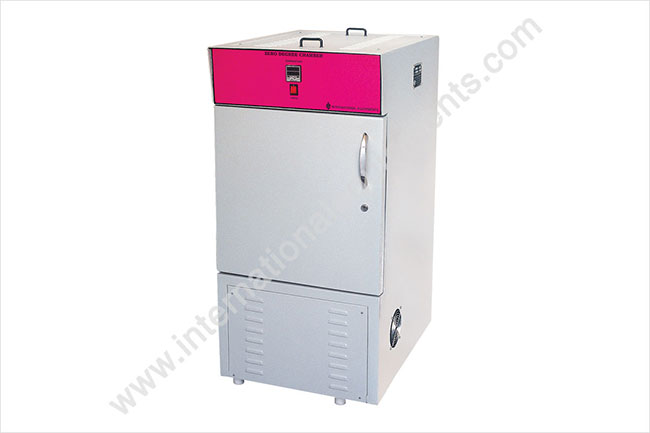
International Equipments is a leading manufacturer, supplier and exporter of Digital Zero Degree Chambers - also called Conditioning Chambers, Low-Temperature Conditioning Baths or Pipe Pre-Conditioning Chambers - in India. Built at our Mumbai facility, our Digital Zero Degree Chamber is a precision low-temperature pre-conditioning chamber that holds plastic pipe samples (PVC, HDPE, corrugated PLB duct) at exactly 0°C before they are subjected to drop-weight impact testing, strictly as per IS 4984 and IS 12235 (Part 9).

Low-temperature impact testing is one of the most important QC tests for any plastic pipe that will be installed outdoors or in cold-climate service. PVC water pipes, HDPE water and sewerage pipes, and corrugated HDPE PLB ducts all become more brittle at low temperatures - and the relevant Indian Standards require impact testing at the worst-case low temperature (typically 0°C) to confirm the pipe can withstand impact loading in the coldest conditions it will encounter in service.
Zero Degree Chamber

Specifications Table

ParameterSpecification
Size of Working Chamber16 inch x 16 inch x 16 inch* (other sizes available on request)
Material of Inner BathS.S. (Stainless Steel)
Material of Outer BodyM.S. (Mild Steel)
Compressor / RefrigerationCFC-free (environmentally compliant refrigerant)
Paint FinishPowder coated
Power Supply230 Volts, 50 Hz, single phase
Primary ApplicationPre-conditioning of pipe samples at 0°C for impact test per IS 4984 and IS 12235 (Part 9)

* Chamber with other sizes can also be offered as per the customer's requirement.

★ CLIENT USING THIS MODEL

What is a Zero Degree Chamber?

A Zero Degree Chamber - also called a Conditioning Chamber, Low-Temperature Chamber or Conditioning Bath - is a refrigerated laboratory chamber that maintains samples at a controlled low temperature (typically exactly 0°C, though some standards specify other low temperatures from −5°C up to +5°C) for a specified pre-conditioning period (typically 1 to 4 hours) before testing. The purpose is to ensure the entire pipe sample reaches uniform temperature equilibrium throughout its wall thickness before the impact test is performed.

Pipe impact testing is fundamentally a low-temperature test because plastics become more brittle as temperature drops. By pre-conditioning the sample at 0°C and then performing the impact test within seconds of removal from the chamber, the laboratory captures the worst-case impact behaviour - the real safety margin the pipe must demonstrate to be released for service.

About Our Digital Zero Degree Chamber

Our Digital Zero Degree Chamber is a robust, bench-top refrigerated conditioning chamber designed specifically for pipe impact pre-conditioning duty. The 16 inch × 16 inch × 16 inch working chamber comfortably accommodates the standard 200 mm (8 inch) pipe samples used in IS 4984 and IS 12235 (Part 9) impact testing - large enough to condition multiple samples simultaneously for high-throughput QC.

Construction is heavy-duty: stainless steel (SS) inner bath for corrosion resistance and easy cleaning, mild steel (MS) outer body with powder-coated finish for long lab life. The refrigeration system uses a CFC-free compressor - environmentally responsible and compliant with international refrigerant regulations, giving faster pull-down to 0°C and tighter temperature control.

Standard 230 V / 50 Hz single-phase operation makes the chamber compatible with any standard Indian or export laboratory power point. Other chamber sizes are available on request.

Why Low-Temperature Conditioning is Critical

  • Plastic Becomes More Brittle at Low Temperature
    A PVC water pipe that easily passes impact at 25°C may shatter at 0°C from the same impact energy.
  • Mandatory per IS 4984 and IS 12235 (Part 9)
    Indian Standards explicitly require pre-conditioning at 0°C for impact tests on PVC and HDPE water pipes.
  • Uniform Through-Wall Temperature Equilibrium
    The entire wall thickness must reach 0°C equilibrium so the test measures bulk material brittleness, not a surface-only effect.
  • Required for DOT PLB Duct Specification
    DOT specifications for HDPE PLB telecom duct also require low-temperature impact testing to verify winter installation survivability.
  • Catches Polymer Formulation Issues Before Field Failure
    Periodic low-temperature impact testing catches formulation drift before pipes go to the field.

How the Pipe Conditioning Procedure Works

  • Step 1 - Prepare the Pipe Sample
    Cut a length of pipe to the standard test sample length (typically 200 mm / 8 inches).
  • Step 2 - Load Samples into the Chamber
    Place the prepared samples into the SS inner bath. Set the chamber to 0°C and allow it to stabilise.
  • Step 3 - Hold for the Specified Conditioning Time
    Hold at 0°C for the specified pre-conditioning duration (typically 1-4 hours depending on wall thickness).
  • Step 4 - Transfer to the Impact Tester (Within Seconds)
    Remove a sample and immediately transfer it to the Impact Tester, typically within 5-10 seconds.
  • Step 5 - Perform the Drop-Weight Impact Test
    Drop the specified striker weight from the specified height and observe whether the pipe cracks, splits or remains intact.

Zero Degree Chamber + Impact Tester - The Complete Workflow

The Digital Zero Degree Chamber is the first half of the IS 4984 / IS 12235 (Part 9) low-temperature pipe impact test workflow. The second half is the Impact Tester for Pipes - the drop-weight instrument that delivers the actual impact blow to the conditioned sample.

The Zero Degree Chamber pre-conditions the pipe sample at exactly 0°C for the specified time. The Impact Tester then drops a calibrated weight onto the conditioned sample from the specified height, recording whether the pipe cracks, splits or remains intact. We strongly recommend buying both instruments together - many HDPE, PVC and PLB duct QC laboratories invest in the matched pair as a single quotation, with one commissioning visit and one training programme covering both methods.

Technical Information

  • IS 4984 - Indian Standard for HDPE pipes for potable water supply (low-temperature impact clause)
  • IS 4985 - Indian Standard for unplasticized PVC (uPVC) pipes
  • IS 12235 (Part 9) - Methods of test for uPVC pipes - Impact resistance at 0°C
  • IS 14333 - Indian Standard for HDPE pipes for sewerage system
  • IS 14930 - Indian Standard for HDPE corrugated pipes (telecom PLB duct)
  • ISO 3127 - Determination of resistance to external blows by the round-the-clock method
  • ISO 9854 - Thermoplastics piping systems - Charpy impact test method
  • ASTM D 2444 - Impact Resistance of Thermoplastic Pipe by Means of a Tup (Falling Weight)
  • DOT Specifications - for HDPE PLB duct low-temperature impact testing
  • Pre-conditioning of HDPE water-supply pipe samples at 0°C for IS 4984 impact testing
  • Pre-conditioning of uPVC water-supply pipe samples for IS 4985 / IS 12235 (Part 9)
  • Pre-conditioning of HDPE sewerage pipe samples for IS 14333 impact testing
  • Pre-conditioning of HDPE PLB telecom duct samples for IS 14930 and DOT specification tests
  • Pre-conditioning of CPVC, PPR and other plastic pipe samples
  • General-purpose low-temperature conditioning of polymer test specimens
  • Cold-temperature ageing studies of plastic films, sheets and finished products
  • QC documentation for ISI mark certification of plastic pipes
  • BIS audit demonstration of in-house low-temperature impact testing capability
  • R&D evaluation of new pipe polymer grades and impact-modifier formulations
  • HDPE Pipe Manufacturers (water supply, sewerage, irrigation, gas distribution)
  • uPVC & PVC Pipe Manufacturers (water supply, drainage, sewerage)
  • HDPE PLB Duct Manufacturers (telecom & power cable ducting)
  • CPVC Pipe Manufacturers (hot & cold water plumbing)
  • Polymer & Master-batch Compounders (impact modifier evaluation)
  • Recycled Plastic Pipe Processors
  • Government Testing Labs, NABL Accredited Labs & BIS-Approved Test Houses
  • Telecom Infrastructure Companies (BSNL, BharatNet, Reliance Jio, Airtel)
  • R&D Centres of Plastic Pipe Manufacturers
  • 16 x 16 x 16 inch SS Inner Bath
    Generous working chamber accommodates standard 200 mm pipe samples with room for multiple samples simultaneously.
  • Stainless Steel Inner Bath
    Corrosion-resistant, easy to clean and contamination-free for long-term reliable service.
  • CFC-Free Refrigerant System
    Environmentally responsible refrigerant compliant with modern regulations, faster pull-down to 0°C.
  • Custom Chamber Sizes Available
    Larger or smaller chambers built to your specific pipe sample dimensions.
  • Pairs Naturally with Our Impact Tester for Pipes
    Implements the complete IS 4984 / IS 12235 (Part 9) low-temperature impact test workflow.
  • Robust M.S. Construction with Powder Coat
    Heavy-gauge mild-steel outer body for long service life.
  • ISO & CE Certified Manufacturing
    Built at our Mumbai facility under ISO certified quality systems, CE marked for export.
  • Free Installation, Training & Calibration
    Free on-site commissioning, operator training and a factory calibration certificate.

FAQs

Plastics become significantly more brittle at low temperature. A PVC water pipe that easily passes impact at 25°C may shatter from the same impact energy at 0°C. Indian Standards specify 0°C because it represents the worst-case service temperature most plastic water pipes will encounter.
It depends on pipe wall thickness. Typical conditioning times: thin-walled pipes (3-5 mm wall) - 1-2 hours; medium-walled pipes (5-15 mm wall) - 2-4 hours; thick-walled pipes (15+ mm wall) - 4-6 hours or longer. Please refer to your applicable Indian Standard for exact requirements.
Some standards specify water-bath immersion (faster thermal equilibrium but requires drying before impact testing); others specify air-chamber conditioning (slower but doesn't wet the sample). Our chamber's SS inner bath can be used either way.
The conditioned sample begins warming up the moment it is removed. A 200 mm PVC pipe sample can warm by 1-2°C in just 30 seconds of room air exposure, enough to invalidate the test. Transfer and impact must occur within typically 5-10 seconds.
Yes - common uses include cold-temperature conditioning of Izod/Charpy impact specimens, low-temperature conditioning of dart impact specimens, and general-purpose 0°C conditioning of any laboratory sample.
Yes - modern CFC-free refrigerants (R-134a, R-404A, R-410A) have temperature performance equal to or better than older CFC refrigerants at the 0°C range used for pipe conditioning.
Yes. The Zero Degree Chamber and our Impact Tester for Pipes together implement the IS 4984 / IS 12235 (Part 9) low-temperature pipe impact test workflow. We commonly supply the matched pair as a single quotation.
Yes. Free on-line installation, commissioning, operator training on the IS 4984 / IS 12235 (Part 9) pipe impact test procedure and factory calibration certificate for the temperature controller. Recalibration is done on a yearly basis.

Need a reliable Digital Zero Degree Chamber for pipe impact pre-conditioning?

Contact International Equipments today for a personalised quotation. Tell us your typical pipe diameter range and the test standards you follow (IS 4984, IS 12235 Part 9, IS 14333, IS 14930) - our team will share pricing, delivery timeline and the matched Zero Degree Chamber + Impact Tester package option for the complete IS 4984 low-temperature pipe impact test workflow.

Get Free Quote