Quote Request
Quote
Manufacturers and Suppliers of Charpy Impact Tester / Izod Impact Tester

Universal Testing Machine for Adhesives, Ceramic Tiles & Mosaics — Bond Strength, Shear & Pullout Tester per IS 15477 & ASTM C 307

About Universal Testing Machine for Adhesives, Ceramic Tiles & Mosaics — Bond Strength, Shear & Pullout Tester per IS 15477 & ASTM C 307

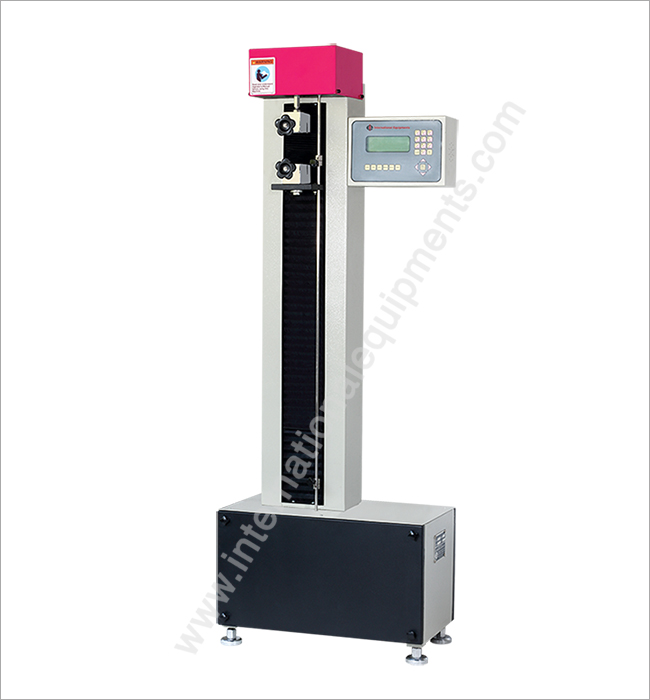
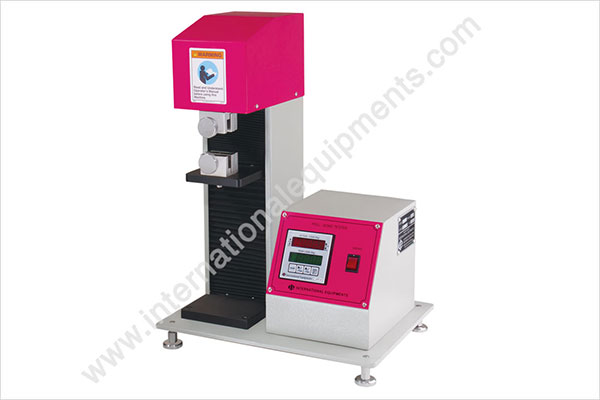
Computerized Twin screw Universal Testing Machine for Adhesives for use with Ceramic Tiles & Mosaics as per above referred Indian standard IS 15477 to determine properties of Shear bond, Adhesion, Pullout Testing, Dolly pullout, Tile Compression testing as per with direct display of results through 4 lines and 20 character 32 bit micro-controller.

International Equipments is a leading manufacturer, supplier and exporter of specialised Universal Testing Machines for Adhesives, Ceramic Tiles and Mosaic Tiles in India. Built at our Mumbai facility, this product is a Computerised Twin-Screw UTM specifically configured for the bond-strength and adhesion test methods required by the Indian Standard IS 15477 — covering shear bond, pullout testing (including the standardised 50 sq mm dolly pullout from a cement substrate), tile-to-substrate de-bonding, flexural strength on cement slabs and tile compression. The machine is supplied with the full set of specialised grips and fixtures needed to perform every test in the standard out of the box.

This specialised UTM serves a fundamentally different customer base from our general Universal Testing Machine — it is designed for adhesive and resin manufacturers (and their end users) producing tile adhesives, construction chemicals, epoxy adhesives, polymer-modified mortars and similar bonded-assembly products. These customers need to verify the adhesion strength their adhesive produces on different substrates — typically ceramic tile to cement slab, mosaic to concrete and similar tile-bonded assemblies — under the controlled test conditions IS 15477 specifies. The right equipment for this work is not a generic UTM but a UTM purpose-configured with the specific grips, fixtures and load capacity that the standard requires.


Universal Testing Machine for Adhesives, Ceramic Tiles and Mosaics India - IS 15477 Compliant Bond Strength, Shear and Pullout Tester (up to 50 kN) by International Equipments

Equipment is offered up to 50 KN (5,000 Kilogram) capacity.

Specifications Table

Parameter Specification
Type Computerised Twin-Screw Universal Testing Machine
Test Standard Coverage IS 15477 (Methods of test for cementitious tile adhesives)
Tests Performed Shear Bond, Adhesion, Pullout Testing, Dolly Pullout (50 sq mm), Tile Compression, Flexural Strength on cement slabs
Maximum Load Capacity Up to 50 kN (5,000 kg)
Display 4 lines × 20 characters, driven by 32-bit microcontroller
Result Output Direct display on the instrument (PC connection available for data logging and graph capture)
Grips & Fixtures Supplied (Standard) Dolly pullout base fixture + holder;
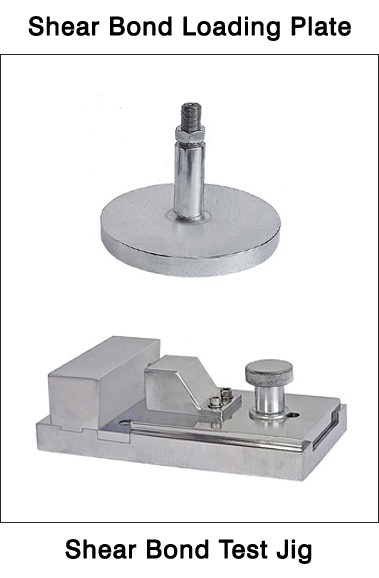
Shear bond loading plate + test jig;
Flexural jig with higher-diameter loading nose;
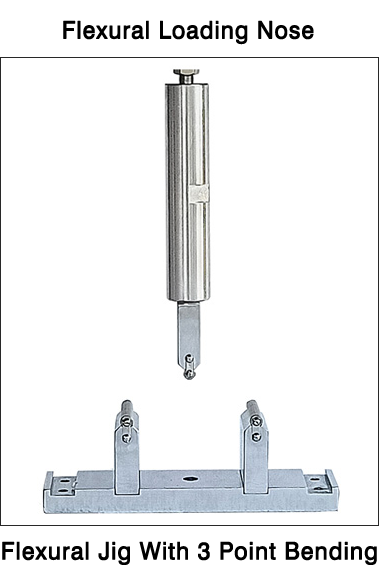
Flexural loading nose + jig (3-point bending)
Primary Application Bond strength, adhesion, pullout, and compression testing of tile adhesives, mosaic adhesives, construction chemicals, polymer-modified mortars and similar bonded assemblies as per IS 15477

What is a Universal Testing Machine for Adhesives, Ceramic Tiles & Mosaics?

A Universal Testing Machine for Adhesives, Ceramic Tiles and Mosaics is a specialised UTM configured specifically to perform the bond-strength and adhesion test methods required by the Indian Standard IS 15477 (Methods of test for cementitious tile adhesives) — covering the tensile pullout, shear bond, flexural strength and tile compression tests that this standard prescribes. While the underlying machine is a twin-column / twin-screw electromechanical UTM (the same class of machine as our general Universal Testing Machine), this variant comes pre-configured with the specialised grips and fixtures that make IS 15477 testing fast, accurate and repeatable.

The four specialised grip / fixture types supplied with this machine are: (1) Dolly pullout base fixture and dolly holder — for the standardised 50 sq mm dolly pullout test where a small metal dolly is glued to a tile and pulled vertically until the adhesive bond fails; (2) Shear bond loading plate and test jig — for in-plane shear loading of a bonded tile assembly; (3) Flexural jig with higher-diameter loading nose — for 3-point bending tests on cement slabs; (4) Flexural loading nose and jig with 3-point bending — for the standard flexural failure test on cement-slab specimens. Together these four configurations cover every test method in IS 15477.

About Our Computerised Twin-Screw UTM

Our Universal Testing Machine for Adhesives, Ceramic Tiles & Mosaics is a Computerised Twin-Screw electromechanical UTM purpose-configured for IS 15477 testing. The twin-screw drive provides smooth, vibration-free crosshead motion across the full speed range — essential for the slow constant-speed loading rates that bond-strength tests require (typically a few mm/min so that the failure point is captured precisely without dynamic effects).

Equipment is offered up to 50 kN (5,000 kg) capacity — covering the full load range needed for IS 15477 testing. Most dolly pullout tests fail at relatively low loads (typically 50-500 N for a 50 sq mm dolly), so the lower load range is used most frequently; the higher 50 kN capacity is available for tile compression tests, large-area shear bond tests and other higher-load adhesion test configurations.

Direct display of test results is via a built-in 4-line × 20-character display driven by a 32-bit microcontroller — gives the operator an immediate readout of peak load, displacement and the bond-strength result at the end of each test without requiring a PC connection for routine testing. PC connectivity is also available for full data logging, force-vs-displacement graph capture and printable test reports — important for NABL-accredited labs and customer-specification verification reports.

All four IS 15477 grip / fixture types are supplied as standard with the machine — no need to source these specialised adhesion-testing accessories from third parties. The machine is supplied factory-calibrated, with the load cell traceable to NABL standards for accurate bond-strength results that customers and certification authorities will accept without dispute.

Types Of Grips For Adhesive testing as per IS 15477 for Tiles and Mosaics

Dolly Pullout Base Fixture and Holder - 50 sq mm Dolly Pullout Test Configuration per IS 15477 for Tile Adhesive Bond Strength by International Equipments
Shear Bond Loading Plate and Test Jig - In-Plane Shear Bond Strength Test Configuration per IS 15477 for Tile Adhesive Testing by International Equipments
Flexural Jig with Higher Diameter Loading Nose - Flexural Strength Test Configuration for Cement Slab Substrates per IS 15477 by International Equipments
Heavy Duty Grips

This equipment is used by adhesive and resin manufacturers as well as their end users for checking the strength of adhesion/bond on different substrates such as Tiles and mosaics. Tests such as 50 square mm Dolly pullout from a cement slab of say 300 mm x 200 mm, Horizontal 40 cubic mm slab three point failure, 100 mmx100 mm tile de-bonding.

Tests Performed — Shear Bond, Adhesion, Pull-out, Tile Compression

The IS 15477 standard prescribes a specific set of bond-strength and adhesion tests for cementitious tile adhesives and similar construction-chemical products. All of these tests are performed on this single machine using the supplied grips and fixtures:

  • Shear Bond Strength
    In-plane shear loading of a bonded tile assembly — measures how strongly the adhesive resists shear forces that would slide the tile across its substrate. Critical for floor tile adhesives (where foot-traffic and dragged-furniture loads are dominantly shear) and for wall tiles in high-shear conditions. Performed using the Shear Bond Loading Plate and Test Jig.
  • Adhesion Strength (Tensile Pullout)
    Tensile loading perpendicular to the bonded surface — measures how strongly the adhesive resists forces that would pull the tile straight off its substrate. This is the most fundamental bond-strength measurement and a key acceptance test for tile adhesives.
  • Dolly Pull-out (50 sq mm Dolly)
    The IS 15477-specified standardised pullout test — a 50 sq mm metal dolly is bonded to a tile installed on a cement substrate, and then pulled vertically at a constant crosshead speed until failure occurs. The peak load at failure is used to calculate bond strength in N/sq mm. Performed using the Dolly Pullout Base Fixture and Holder.
  • Tile & Cube Compression Testing
    Compressive loading on tile specimens — evaluates the compressive strength of the tile itself, independent of adhesive performance. Used for quality control to ensure the tile material is not the limiting factor in bonded system performance. Suitable for use on 50 kN capacity testing systems.
  • Flexural Strength of Cement Substrate (3-Point Bending)
    Flexural loading of cement slab specimens — determines the bending strength and deformation behavior of the substrate prior to bond testing. Helps isolate substrate variability from adhesive performance. Performed using a 3-point bending flexural fixture with appropriate loading nose configuration for specimen size.

Types of Grips & Fixtures Supplied (4 Specialised Configurations)

Four specialised grip and fixture configurations are supplied with the machine — covering every test method in IS 15477 & ASTM C 307. All four are shown on the existing live product page as image thumbnails:

  • Dolly Pull-out Base Fixture and Holder
    Holds the cement slab substrate horizontally in the base fixture while the dolly holder grips the 50 sq mm metal dolly bonded to the tile surface. The testing machine applies a vertical upward pull at a constant crosshead speed until failure occurs. This is the most widely used grip configuration for IS 15477 acceptance testing of tile adhesive bond strength.
  • Shear Bond Loading Plate and Test Jig
    Applies in-plane shear loading to a bonded tile assembly — the specimen is positioned such that the loading plate applies force parallel to the adhesive bond plane rather than perpendicular. This configuration directly measures shear bond strength under conditions similar to floor service loads.
  • Flexural Jig with Higher-Diameter Loading Nose
    A 3-point bending fixture equipped with a larger-diameter, rounded loading nose. Used for flexural testing of cement slab substrates where the increased contact radius reduces stress concentration at the loading point. Suitable for thicker or larger substrate specimens.
  • Flexural Loading Nose and Jig (3-Point Bending)
    Standard 3-point bending configuration used for flexural strength testing of cement slab substrates and other rectangular brittle materials. Provides baseline modulus of rupture data for substrate characterization prior to adhesive bond testing.
  • Briquette Tensile Test (Moulded Cement Dumbbell)
    Tensile testing of cement mortar briquettes cast in a standardized dumbbell-shaped mould. Requires dedicated grips to properly align and hold the specimen during axial loading until fracture. Widely used in concrete and cement quality control to determine tensile strength of mortar mixes.

Original Usage / Examples

  • 50 sq mm Dolly Pull-out from 300 mm × 200 mm Cement Slab
    The most common IS 15477 test configuration. A 50 sq mm metal dolly is bonded to a ceramic tile (using the test adhesive), which is itself bonded to a 300 mm × 200 mm cement slab substrate. After curing, the dolly is pulled vertically at a constant speed until adhesive failure occurs. The peak load divided by the dolly area gives bond strength in N/sq mm.
  • Horizontal 40 Cubic mm Slab — Three-Point Bending Failure
    Flexural testing of a small cement slab specimen (40 cubic mm volume) using a 3-point bending setup until fracture. Used for substrate characterization and evaluation of brittle bonded-mortar specimens under bending stress.
  • 100 mm × 100 mm Tile De-bonding
    Full-area tile-substrate de-bonding test on a 100 mm × 100 mm tile specimen. The tile is fully adhered to the substrate and then subjected to tensile loading until separation occurs. This evaluates overall bond performance across the entire bonded interface rather than a localized dolly area.

Why Specialised Adhesive / Tile Testing is Critical

Specialised adhesive and tile bond-strength testing is non-negotiable for any construction-chemical manufacturer or tile adhesive producer. Five reasons in-house IS 15477 testing capability is essential:

  • BIS / ISI Mark Certification Under IS 15477
    • BIS certification of tile adhesives, polymer-modified mortars and similar cementitious tile-bonding products requires demonstrated in-house testing capability for every test method specified in IS 15477.
    • Without this equipment, ISI mark certification cannot be obtained for these products.
  • Mandatory Customer Acceptance Documentation
    • Large construction projects, government tenders, real-estate developers and architectural specifications require documented IS 15477 bond-strength test reports along with dispatch documentation.
    • Without in-house testing, every batch must be sent to an external laboratory, increasing cost and delaying shipment.
  • Catches Formulation Drift in Polymer-Modified Mortars
    • Tile adhesive bond strength is highly sensitive to formulation variables such as polymer redispersible powder content, cellulose ether dosage, and cement-to-aggregate ratio.
    • Routine in-house testing helps identify formulation drift before defective batches reach customers.
  • Validation of New Adhesive Grades and Substrate Combinations
    • Every new adhesive formulation and substrate type, including porcelain tiles, vitrified tiles, glass mosaics, and natural stone, must be qualified through bond-strength testing before commercial release.
    • In-house testing capability makes product development faster and more economical.
  • Failure Investigation and Customer Complaint Response
    • Field failures such as de-bonding, tile lifting, and cracking require rapid root-cause analysis.
    • In-house testing enables quality teams to investigate and respond within hours rather than waiting days for external laboratory results.

How the IS 15477 Bond-Strength Tests Work

The standardised 50 sq mm dolly pullout test under IS 15477 is the most-used test method. The procedure:

  • Step 1 — Prepare the Substrate

    Cast or obtain a cement slab substrate of the dimensions specified by the standard (typically 300 mm × 200 mm or as required by the customer specification). Cure the substrate under standard conditions for the specified time before bonding the tile.

  • Step 2 — Apply the Test Adhesive and Bond the Tile

    Apply the test adhesive to the cured cement substrate following the manufacturer's recommended procedure (notched trowel application, working time, open time). Press the ceramic or mosaic tile onto the adhesive bed. Allow the adhesive to cure for the specified time and under the specified conditions (standard cure, water-immersion cure, heat-aged cure).

  • Step 3 — Bond the 50 sq mm Dolly to the Tile

    After the adhesive has cured, glue a 50 sq mm metal dolly to the upper face of the tile using a high-strength quick-setting adhesive (typically epoxy). Allow the dolly bond to cure fully, typically overnight.

  • Step 4 — Mount the Specimen in the Dolly Pullout Fixture

    Place the cement slab specimen on the dolly pullout base fixture and position it so the bonded dolly is centred under the dolly holder. Engage the dolly holder with the dolly. Configure the crosshead to apply constant tensile loading at the specified speed.

  • Step 5 — Apply Tensile Load to Failure and Calculate Bond Strength

    Start the crosshead motion at constant speed. The dolly is pulled vertically upward at the constant rate until the adhesive bond between tile and substrate fails. The peak load at failure is recorded. Bond strength is calculated as peak load divided by dolly area (50 sq mm).Compare the result against the IS 15477 acceptance threshold or the customer specification to determine pass/fail.


Adhesives UTM vs General UTM — Which Do I Need?

Many customers ask whether this specialised UTM differs from our general Universal Testing Machine — and which they should buy. Both are twin-column / twin-screw electromechanical UTMs, but they are configured for different applications:

  • Specialised Adhesives / Tile UTM (This Product) — for Construction Chemicals

    Pre-configured with the four IS 15477 grip / fixture types — dolly pullout, shear bond, flexural with higher-diameter nose, and flexural with 3-point bending. Targeted at adhesive and resin manufacturers, tile-adhesive producers, polymer-modified mortar makers, and construction-chemical companies. Available with capacities up to 50 kN. Use this product if your primary work is adhesive or tile bond-strength testing as per IS 15477.

  • General Universal Testing Machine — for Polymers, Plastics, Pipes, and Films

    Twin-column computerised UTM configured with standard polymer and plastic grips for tensile, compression, flexural, peel, and bond-strength testing on plastic and polymer specimens. Higher load capacities are available, along with specialised configurations such as pipe ring stiffness, internal COF for PLB duct, and pipe or film tensile fixtures.Use the main UTM page if your primary work is polymer, plastic, pipe, or film mechanical testing.

  • Can the Same Machine Do Both?

    Yes — both machines share the same underlying twin-screw electromechanical platform, and grip / fixture sets can be added to either machine. Some customers buying the main UTM also order the IS 15477 grip set as an add-on, and some customers buying the Adhesives UTM later add standard polymer grips. Please mention your full test scope in the enquiry — our team can confirm whether one machine with multiple grip sets is the right solution for you.
Technical Information

  • IS 15477 — Methods of Test for Cementitious Tile Adhesives (Primary Indian test standard)
  • IS 15662 — Specification for Thin Bed Ceramic Tile Adhesives
  • EN 1308 — Adhesives for Tiles — Determination of Slip
  • EN 1346 — Adhesives for Tiles — Determination of Open Time
  • EN 1348 — Adhesives for Tiles — Determination of Tensile Adhesion Strength for Cementitious Adhesives
  • EN 12002 — Adhesives for Tiles — Determination of Transverse Deformation for Cementitious Adhesives
  • EN 12004 — Adhesives for Tiles — Requirements, Evaluation of Conformity, Classification and Designation
  • ANSI A118 Series — American National Standards Institute Specifications for Tile-Setting Adhesives
  • ASTM C482 — Standard Test Method for Bond Strength of Ceramic Tile to Portland Cement Paste
  • ASTM C1583 — Standard Test Method for Tensile Strength of Concrete Surfaces and Bond Strength of Repair/Overlay Materials
  • Bond strength testing of cementitious tile adhesives per IS 15477
  • Bond strength testing of polymer-modified mortars and construction chemicals
  • Bond strength testing of epoxy adhesives for tile and stone applications
  • Adhesion testing of mosaic tile adhesives to concrete and screed substrates
  • Bond strength testing of porcelain tile, vitrified tile, glass mosaic and natural stone installations
  • Shear bond strength testing of tile-substrate assemblies
  • Dolly pullout testing for tile adhesive quality control and acceptance
  • Tile compression testing for ceramic and porcelain tile quality control
  • Flexural strength testing of cement slab substrates
  • Bond strength testing of cementitious tile grout to tile edges
  • Bond strength testing of stone-fixing mortars to facade substrates
  • Validation of new tile adhesive formulations and polymer redispersible powder grades
  • Recycled-content tile adhesive verification
  • Government tender dispatch documentation for tile adhesive supplies
  • Failure-mode investigation for de-bonded tile installations
  • Tile Adhesive Manufacturers (cementitious and polymer-modified)
  • Construction Chemical Companies (admixtures, mortars, repair products)
  • Epoxy and Polyurethane Adhesive Manufacturers (tile and stone adhesives)
  • Polymer Redispersible Powder Producers (raw material for tile adhesives)
  • Cellulose Ether Producers (raw material for tile adhesives)
  • Ceramic Tile Manufacturers (tile quality control and bond verification)
  • Mosaic Tile and Glass Mosaic Manufacturers
  • Natural Stone and Stone-Fixing Mortar Producers
  • Real Estate Developers and Construction Companies (incoming material quality control)
  • Government Construction Departments and Public Works Agencies
  • Tile Installation Contractors (specialist quality control)
  • Government Testing Laboratories, NABL-Accredited Laboratories, and BIS-Approved Test Houses
  • Educational Institutions Teaching Construction Materials and Civil Engineering
  • Research and Development Centres of Adhesive, Polymer, and Construction Chemical Companies
  • Purpose-Configured for IS 15477 Out of the Box
    Comes pre-configured with the four specialised grip/fixture types needed for IS 15477 testing — dolly pullout, shear bond, flexural with higher-diameter loading nose, and 3-point bending. No need to source specialised accessories from third parties; every test in the standard is supported from day one.
  • Up to 50 kN Capacity — Covers the Full IS 15477 Load Range
    The 50 kN (5,000 kg) maximum load capacity covers everything from low-load dolly pullout tests (typical 50–500 N) up through high-load tile compression and large-area shear bond tests. One machine handles every IS 15477 test configuration.
  • Computerised Twin-Screw Drive for Smooth Loading
    Twin-screw electromechanical drive provides smooth, vibration-free crosshead motion across the full speed range, essential for accurate bond-strength results at the slow constant loading rates required by these tests.
  • Direct On-Instrument Display Plus PC Connectivity
    Built-in 4-line × 20-character display driven by a 32-bit microcontroller provides immediate readout of peak load and bond-strength results without requiring a PC. Optional PC connectivity enables complete data logging, force-versus-displacement graphs, and printable reports for NABL laboratories and customer specification verification.
  • Specialised Niche Expertise
    We have built and installed adhesive and tile testing UTMs at multiple Indian construction chemical and tile adhesive manufacturing facilities. Our team understands the specific requirements of this industry far better than a general-purpose UTM supplier. Client references are available on request.
  • Customisation for Specific Test Configurations
    Need a non-standard dolly size, larger substrate fixture, or a specific curing-cell add-on? Our engineering team can configure the machine to your exact testing requirements. Custom grips and fixtures are available on request.
  • Full Coverage of IS, EN and ASTM Adhesive Standards
    Beyond IS 15477, the system supports EN 1308, EN 1346, EN 1348, EN 12002, EN 12004, ANSI A118 Series, and ASTM C482/C1583. A single instrument can address Indian, European, and American tile adhesive testing specifications.
  • ISO Certified, CE Marked Manufacturing
    Designed and manufactured at our Mumbai facility under ISO-certified quality systems, with CE marking available for export markets including the Middle East, Africa, South-East Asia, Europe, and South America.
  • Free Installation, Training & Calibration Online
    Includes free online commissioning, operator training covering the complete IS 15477 methodology (substrate preparation, adhesive curing, dolly bonding, test execution, and result calculation), along with a factory-issued NABL-traceable load cell calibration certificate.

FAQs

Both machines share the same underlying twin-column / twin-screw electromechanical UTM platform, but they are configured for different applications. This product comes pre-configured with the four IS 15477 grip / fixture types — dolly pull-out base & holder, shear bond loading plate & test jig, flexural jig with higher-diameter loading nose, and 3-point bending fixture — making it ready for adhesive and tile bond-strength testing out of the box. Our main UTM is configured with standard polymer and plastic grips for tensile, compression, flexural and peel testing. If your primary work is adhesive and tile testing per IS 15477, choose this specialised variant.
The 50 sq mm dolly pullout test is the standardised IS 15477 acceptance test for tile adhesive bond strength. A metal dolly is bonded to a tile specimen using high-strength epoxy, and the tile is adhered to a cement substrate using the test adhesive. After curing, the dolly is pulled vertically until failure occurs. The peak load divided by the dolly area gives bond strength directly in N/mm². The standardised dolly size ensures comparable results between laboratories, production batches and adhesive grades.
Yes. The same IS 15477 methodology can be applied to ceramic tiles, porcelain tiles, vitrified tiles, mosaic tiles, glass mosaics and natural stone bonded to cementitious substrates. For very thin glass mosaics or unusually thick stone specimens, custom dolly holders and substrate fixtures can be supplied upon request.
Most dolly pullout tests fail at relatively low loads, typically between 50 and 500 N. However, the full 50 kN capacity becomes important for tile compression testing, large-area shear bond testing, thick cement slab flexural testing and future testing requirements. A 50 kN machine ensures complete coverage of all IS 15477 test configurations.
The standard supply includes the UTM and the four IS 15477 grip and fixture types. Cement substrate moulds, cure cells, specimen preparation fixtures and dolly bonding accessories are generally supplied separately because they vary based on substrate size and laboratory workflow. We can provide a complete accessory package based on your requirements.
In many cases, yes. The IS 15477 grips and fixtures can be retrofitted to compatible electromechanical UTMs, including our standard Universal Testing Machine models. If you already own a UTM, we can evaluate its load capacity, crosshead clearance and speed range and quote the specialised fixture package separately.
As a general guideline, cementitious tile adhesives classified under IS 15662 typically achieve at least 0.5 N/mm² bond strength for Type C1 adhesives and at least 1.0 N/mm² for Type C2 (improved) adhesives after standard curing conditions. Actual acceptance criteria depend on adhesive classification and conditioning requirements defined in the applicable standard.
Yes. We provide free online installation and commissioning, operator training covering the complete IS 15477 testing methodology, guidance on specimen preparation and bond-strength calculations, and a factory-issued NABL-traceable load cell calibration certificate.

Setting up the QC laboratory at your tile adhesive, construction chemical, polymer-modified mortar or epoxy adhesive manufacturing plant?

Contact International Equipments today for a personalised quotation on the Universal Testing Machine for Adhesives, Ceramic Tiles & Mosaics. Tell us your test standards (IS 15477, IS 15662, EN 1348, EN 12004, ASTM C 482), the specific test methods you need (50 sq mm dolly pullout, shear bond, tile compression, flexural), and any specialised dolly sizes or substrate dimensions — our team will share pricing, delivery timeline and the list of leading construction chemical and tile adhesive manufacturers already using our specialised Adhesives UTM.

Get Free Quote