Quote Request
Quote
Manufacturers and Suppliers of Charpy Impact Tester / Izod Impact Tester

Muffle Furnace — Laboratory High-Temperature Furnace Manufacturer in India

About Muffle Furnace

To determine percentage of ash in polymers. Furnace with other sizes can also be offered.

International Equipments is a leading manufacturer, supplier and exporter of Laboratory Muffle Furnaces in India. Built at our Mumbai facility, our Muffle Furnace is a precision high-temperature furnace designed to heat samples up to 1150°C in a controlled, insulated chamber - the standard instrument used by plastic, polymer, rubber, packaging, ceramic and quality testing laboratories for ash content determination, carbon black content testing, loss on ignition, sample preparation and many other high-temperature laboratory operations.

Ash content - the inorganic residue left after a polymer sample is completely burned - is one of the most important QC parameters in the plastic industry. It tells you the mineral filler content of a compounded polymer, the contamination level of recycled plastic, and is the foundation of the carbon black content test for HDPE pipe and PLB duct material. The Muffle Furnace is the dedicated, accurate instrument that delivers this measurement, working alongside the Hot Air Oven to form the complete thermal-test setup found in every well-equipped polymer QC laboratory.
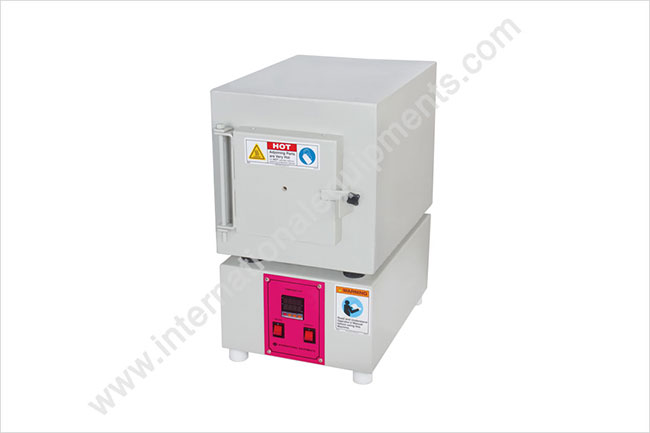
Exporters Of Muffle Furnace

Specifications Table

ParameterSpecification
Size of the Working Chamber4 inch x 4 inch x 9 inch* (other sizes available on request)
Material of ConstructionM.S. (Mild Steel)
Temperature RangeAmbient to 1150°C
Paint FinishPowder coated
Power Supply230 Volts, 50 Hz, single phase
Primary ApplicationDetermination of percentage of ash in polymers

* Furnace with other sizes can also be offered as per the customer's requirement.

★ CLIENT USING THIS MODEL

What is a Muffle Furnace?

A Muffle Furnace - also called a High-Temperature Furnace, Ash Furnace, Box Furnace or Laboratory Furnace - is a heating chamber that holds samples at a controlled high temperature (typically up to 1100-1200°C) in an isolated 'muffle' chamber. The term 'muffle' refers to the way the heating element is separated from the sample chamber - heat reaches the sample by radiation and conduction through a refractory chamber wall, rather than the flue gases or heating element coming into direct contact with the sample. This isolation is what allows clean, contamination-free high-temperature work.

Muffle Furnaces are one of the most frequently used pieces of laboratory equipment in the plastic, polymer, rubber, ceramic, metallurgy, chemistry and material-testing industries - essential for any test where the polymer must be burned away completely so that only the inorganic residue (ash) remains.

About Our Laboratory Muffle Furnace

Our Laboratory Muffle Furnace is built with a mild-steel outer body, powder-coated finish for long lab life, and a working chamber of 4 inch × 4 inch × 9 inch - a practical size that accommodates the standard porcelain or ceramic crucibles used for ash and carbon black content testing. Other chamber sizes can be supplied on request.

Temperature control is by a precision controller covering the full ambient-to-1150°C range - comfortably above the 800°C and 950°C burn temperatures used by ASTM D 1603 (carbon black content) and the related ash-content standards. The refractory-lined chamber heats up cleanly and holds it stable while the sample is burned to completion - typically a 30-minute to several-hour cycle.

The chamber design and refractory lining minimise heat loss, give fast warm-up, and protect the sample from contamination by flue gases or heating element materials - delivering accurate, reproducible ash percentages and long-term durability for high-volume daily testing.

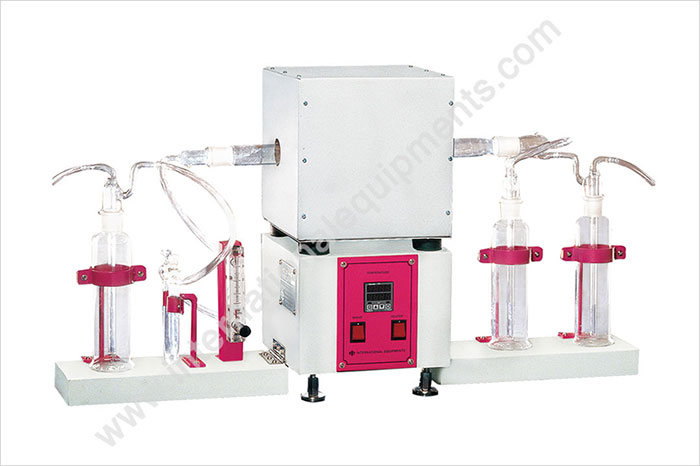
Why Muffle Furnace Testing Matters

  • Ash Content for Filler Loading Verification
    The furnace burns away all the polymer at 600-800°C, leaving only the inorganic filler behind - the essential QC check that the compounder delivered material on specification.
  • Carbon Black Content (ASTM D 1603 / D 4218)
    For HDPE pipes and outdoor polyolefin products, carbon black content (typically 2.0-2.5%) is the most important UV-protection QC parameter.
  • Loss on Ignition (LOI) for Coated Substrates
    Determines organic content of a coated, impregnated or composite material by burning off the organic portion and measuring weight loss.
  • Sample Preparation for ICP, AA and XRF Analysis
    The Muffle Furnace is the standard instrument for converting an organic sample to inorganic ash before analytical chemistry.
  • Required for ISI Mark, NABL & BIS Audits
    BIS certification for ISI mark on HDPE, uPVC and PVC pipes all require in-house ash content / carbon black content testing capability.

How the Ash Content Test Works

  • Step 1 - Weigh the Empty Crucible
    Weigh a clean, dry crucible on a precision balance and record the empty-crucible weight (W1).
  • Step 2 - Add Sample and Re-Weigh
    Place a measured quantity of polymer sample into the crucible. Re-weigh and record the combined weight (W2).
  • Step 3 - Burn in the Muffle Furnace
    Set the controller to the burn temperature specified by your test method - typically 600°C, 800°C or 950°C. Hold until all organic polymer has burned away cleanly.
  • Step 4 - Cool, Re-Weigh and Calculate
    Cool the crucible in a desiccator, re-weigh (W3), and calculate: Ash % = (W3 - W1) / (W2 - W1) x 100.

Muffle Furnace vs Hot Air Oven - Key Differences

  • Muffle Furnace - Choose When You Need
    To burn organic samples away to determine ash content (600-950°C); run ASTM D 1603 / D 4218 carbon black tests; perform Loss on Ignition; or any high-temperature operation up to 1150°C.
  • Hot Air Oven - Choose When You Need
    To dry samples without burning them (ambient to 250C); condition samples before tensile/impact testing; run accelerated heat-ageing studies. See Hot Air Oven.
  • Most Polymer QC Labs Buy Both
    The Hot Air Oven (≤250°C) and the Muffle Furnace (≤1150°C) are complementary - together they cover the full temperature range of polymer QC.

Technical Information

  • ASTM D 5630 - Standard Test Method for Ash Content in Plastics
  • ASTM D 1603 - Standard Test Method for Carbon Black Content in Olefin Plastics
  • ASTM D 4218 - Determination of Carbon Black Content in Polyethylene Compounds by the Muffle-Furnace Procedure
  • ASTM D 297 - Standard Test Methods for Rubber Products - Chemical Analysis (ash content clause)
  • ISO 3451-1 - Plastics: Determination of ash - General methods
  • ISO 247 - Rubber: Determination of ash
  • IS 13360 (Part 4) - Indian Standard methods of test for plastics - ash content
  • IS 4984 / IS 14333 - HDPE pipe standards (carbon black content clauses)
  • ISO 1172 - Textile-glass-reinforced plastics - Determination of loss on ignition
  • Ash content determination of plastic granules, polymer compounds and finished plastic products
  • Carbon black content testing of HDPE water pipes (ASTM D 1603 / D 4218)
  • Carbon black content of PE gas pipes, HDPE PLB ducts and outdoor polyolefin products
  • Ash content of rubber, TPE and elastomer compounds
  • Filler loading verification in mineral-filled PP, PE, ABS and PVC compounds
  • Loss on Ignition (LOI) testing of paints, coatings and composite materials
  • Sample preparation for ICP, AA and XRF analytical chemistry
  • Burn-off of binder material in glass-fibre composite QC
  • Calcination of ceramic samples and refractory materials
  • Ash determination in paper, board, textile and woven-product samples
  • High-temperature stability testing of new polymer formulations (R&D)
  • QC documentation for ISO 9001, NABL and BIS audits
  • HDPE Pipe Manufacturers (water supply, sewerage, irrigation, gas)
  • uPVC & PVC Pipe Manufacturers
  • HDPE PLB Duct Manufacturers (telecom & power cable ducting)
  • Plastic Film, Sheet & Flexible Packaging Producers
  • Polymer Producers and Master-batch Compounders
  • Recycled Plastic Processors
  • Rubber, TPE & Elastomer Manufacturers
  • Glass-Fibre Composite & FRP Fabricators
  • Paint, Coating & Adhesive Manufacturers
  • Ceramic Tile, Refractory & Cement Industry
  • Government Testing Labs, NABL Accredited Labs & BIS-Approved Test Houses
  • Ambient to 1150°C Range
    Comfortably covers the 600-950°C burn temperatures used by ASTM D 1603, D 4218, D 5630 and related standards.
  • Standard 4 x 4 x 9 inch Chamber
    Practical size for standard porcelain and ceramic crucibles used in ash and carbon black testing.
  • Custom Chamber Sizes Available
    Larger or smaller chambers built to the customer's specific batch size and crucible inventory.
  • Refractory-Lined Muffle Chamber
    Isolated from direct contact with the heating element and flue gases - clean, contamination-free heating.
  • Robust M.S. Construction, Powder Coated
    Heavy-gauge mild-steel outer body for long service life in busy QC laboratory environments.
  • Complete Polymer QC Range from One Supplier
    Pairs with our Hot Air Oven, Carbon Black Content Apparatus, Density Apparatus and Moisture Analyser.
  • ISO & CE Certified Manufacturing
    Built at our Mumbai facility under ISO certified quality systems, CE marked for export.
  • Free Installation, Training & Calibration
    Free on-site commissioning, operator training and a factory calibration certificate.

FAQs

A Hot Air Oven is a low-to-medium temperature instrument (typically ambient to 250°C) used for drying, conditioning, ageing and curing samples WITHOUT burning them. A Muffle Furnace is a high-temperature instrument (typically up to 1100-1200°C) used to burn the polymer completely so only the inorganic residue (ash) remains. The two complement each other and most polymer QC labs need both.
It depends on the polymer and application. Pure polymers (virgin HDPE, LDPE, PP, PVC without filler) typically have very low ash content, well under 1%. Mineral-filled polymers can have 10%, 20% or even 40% ash depending on filler loading. HDPE pipe-grade material has a controlled carbon black content of 2.0% to 2.5%.
Carbon black content per ASTM D 1603 requires controlled-atmosphere heating in nitrogen - typically done in a dedicated Carbon Black Content Apparatus. ASTM D 4218 can in principle be run in a standard muffle furnace with appropriate gas-flow modifications. The Muffle Furnace covers all other ash content tests and serves as the workhorse high-temperature instrument.
It depends on the standard you follow. ASTM D 5630 specifies 600°C for plastics. ASTM D 297 for rubber typically uses 550°C. ISO 3451-1 specifies various temperatures depending on the polymer type - 800°C is common. Always refer to the specific test standard you must follow.
The actual high-temperature burn cycle is typically 30 minutes to 2 hours depending on the sample size, polymer type and standard followed. End-to-end, a single ash content test takes about 2-4 hours including warm-up, cooling and weighing.
Standard porcelain crucibles are suitable for most ash content work below 1000°C. For higher temperatures, platinum or platinum-rhodium alloy crucibles are used. Crucibles are NOT included with the Muffle Furnace standard supply.
Yes - at temperatures within its 1150°C range. Widely used for calcination of ceramic raw materials, burn-out of organic binders in ceramic green bodies, and qualification of refractory samples.
Yes. We provide free on-line installation, commissioning, operator training on the ash content test procedure and a factory calibration certificate for the temperature controller at the customer's location anywhere in India.

Need a reliable Muffle Furnace for ash content, carbon black content or general high-temperature laboratory work?

Contact International Equipments today for a personalised quotation. Tell us your typical sample size, target burn temperature and the test standards you follow - our team will recommend the right chamber size, suggest matching companion equipment and share pricing, delivery timeline and the list of leading polymer and pipe manufacturers already using our Muffle Furnaces.

Get Free Quote