Request
Quote

As per ASTM D - 1894 to determine the coefficients of friction of plastic films and sheeting.
The Static and Kinetic Friction Tester is built strictly to ASTM D 1894 — the global reference standard for measuring the coefficient of friction of plastic film, plastic sheeting and flexible packaging films. The instrument places a weighted 200-gram sled (covered with the second test surface) on top of a fixed sample, then pulls the sled at the specified constant speed of 150 mm/minute while a load cell records the pulling force. The instrument directly displays both Static COF (the initial peak before sliding starts) and Kinetic COF (the steady-state value once sliding is established).
Capacity up to 9.999 kg covers light packaging films (where the friction force may be only a few grams) through to heavier industrial laminates and woven products. The three supplied S.S. templates allow the operator to test film-to-film, film-to-metal and other standard surface pair combinations as the test requirement dictates.
The same instrument is offered in two variants — Digital (with direct readout of static and kinetic values on the controller) and Computerized (with PC interface for graph plotting, multi-sample averaging and report printing).
★ CLIENT USING THIS MODEL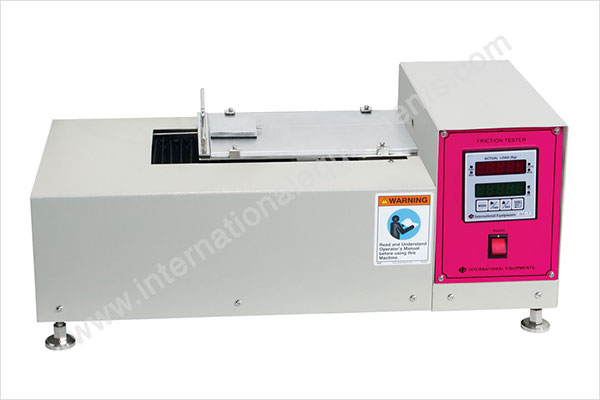
As per Tappy T - 815 standard to determine the coefficients of friction between film to film, film to metal and film to glass.
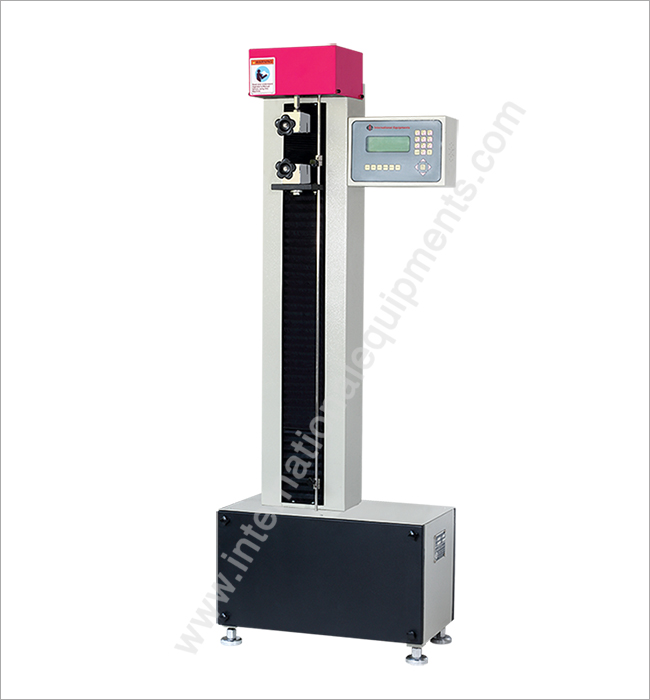
The Inclined Plane Tester is built to TAPPI T-815 — the standard COF test specified by the paper, paperboard, corrugated packaging and tissue industries. The test sample is placed on a flat plane, the 750-gram sled (covered with the second test surface) is placed on top, and the plane is slowly tilted upward at the specified rate of 1.5° to 2.0° per second. The angle at which the sled just begins to slide is recorded; the tangent of that angle is the Static Coefficient of Friction.
The TAPPI T-815 method is particularly well-suited to inter-sheet friction measurements where it is essential to know the angle at which printed sheets, paperboard, corrugated boxes or stacked products will begin to slip. The 4-inch by 2-inch sled is the standard TAPPI specimen geometry. Two S.S. templates are supplied for the standard film-to-film, film-to-metal and film-to-glass surface combinations.
Compared to the horizontal-plane ASTM D 1894 instrument, the Inclined Plane Tester gives ONLY the Static COF (since there is no constant sliding phase). For applications that require both Static AND Kinetic COF, the Static & Kinetic Friction Tester is the right choice. For applications governed by TAPPI standards (paper and packaging industry), the Inclined Plane Tester is the right choice.
★ CLIENT USING THIS MODEL
You need to test plastic film, sheeting or flexible packaging laminates per ASTM D 1894; you must report BOTH Static AND Kinetic COF values (most film specifications require both); your customer specifications mention 'ASTM D 1894 COF' or 'slip and antiblock test'; or you need PC software for statistical analysis of multiple samples (Computerized variant).
You need to test paper, paperboard, corrugated boxes or printed sheets per TAPPI T-815; you need only the Static COF (slide angle); your customer specifications mention 'TAPPI T-815' or 'slide angle test'; or you work in the paper and packaging industry where TAPPI is the reference body.
You serve customers in both the plastic film/flexible packaging industry AND the paper/board/corrugated packaging industry; you run a contract testing laboratory that needs to report against any standard customers specify; or your QC laboratory must serve audits from multiple end customers each using a different standard.
International Equipments is a leading manufacturer, supplier and exporter of Coefficient of Friction (COF) Testers in India. Built at our Mumbai facility, our COF Tester range includes the Static and Kinetic Friction Tester (compliant with ASTM D 1894) and the Inclined Plane Tester (compliant with TAPPI T-815) — covering every common friction measurement requirement for plastic films, flexible packaging, paper, board, laminates and a wide range of finished products.
Coefficient of Friction is one of the most important surface properties of any plastic film, packaging laminate or paper product. Too high a COF causes packaging machines to jam, films to drag and tear on conveyor surfaces, and bottles to stick on bottling lines. Too low a COF makes film rolls slip, pallets of bags lose stack stability, and slip-prone surfaces become a safety hazard. A reliable COF Tester gives the film, packaging or paper manufacturer the data needed to control these issues batch-by-batch.
STATIC & KINETIC FRICTION TESTER (ASTM D 1894) INCLINED PLANE TESTER (TAPPI T-815) REQUEST A QUOTE
Coefficient of Friction directly affects the performance of plastic film, flexible packaging and paper products at the converter, packer and end-user level. Here are the main reasons every film and packaging QC lab needs a COF Tester:
Pre-stretched film, BOPP film, polyethylene film and laminated packaging films all run on automatic packaging machines at high speed. If the film's COF is too high, the film drags, machines jam, and packaging-line throughput drops. Manufacturers add slip agents (erucamide, oleamide) to control COF — and verify the COF on every roll before shipping.
Cement bags, fertiliser bags, rice bags, sugar bags and woven sacks are stacked on pallets and trucks. If the bag's COF is too low, the stack slips and topples in transit. Too high, and machine handling is difficult. COF testing of woven sack and FIBC fabric is part of standard QC for these products.
Bottle filling, capping and labelling lines depend on bottles sliding smoothly along stainless-steel guide rails. The COF between the plastic bottle surface and the guide rail (film-to-metal COF) is the parameter that determines whether the line runs smoothly or jams.
Paper, board and carton-printing converters test inter-sheet COF to ensure printed sheets feed correctly through printing and folding machines and stack securely after die-cutting.
Pressure-sensitive labels and self-adhesive films need controlled COF on both the print side (so they feed through label applicators without skewing) and the release-liner side.
Anti-slip mats, safety flooring and grip-coated products require a controlled MINIMUM COF — the Inclined Plane Tester is the standard equipment used to verify these slip-resistant claims.
We offer two complementary COF Tester models, each built to a different international standard. Many film, packaging and paper QC laboratories purchase both — covering every COF specification that may appear in their customer requirements:
The Static and Kinetic Friction Tester is the standard horizontal-plane COF instrument built to ASTM D 1894 — the dominant standard worldwide for plastic film and sheeting COF. It is offered in two variants — a Digital model with direct display of Static and Kinetic COF values, and a Computerized model with PC interface, Load-vs-Travel graphing, and statistical analysis of multiple samples.
The Inclined Plane Tester is the alternative tilt-plane COF instrument built to TAPPI T-815 — the dominant standard in the paper, paperboard and corrugated packaging industries. It directly measures the angle of slip between film-to-film, film-to-metal and film-to-glass surface pairs.
Related Products



Contact International Equipments today for a personalised quotation, demo video, or factory visit. Our team is ready to help you choose the right Inclined Plane Tester for your laboratory.
Get Free Quote