Quote Request
Quote
Manufacturers and Suppliers of Charpy Impact Tester / Izod Impact Tester

Digital Moisture Analyser — Halogen-Lamp Moisture Apparatus for Polymer Granules, Plastic Powders & Hygroscopic Materials

About Digital Moisture Apparatus

Halogen-lamp loss-on-drying Moisture Analyser for polymer granules, plastic powders, food and agricultural samples - EMFC weighing, 0.001 g resolution, 0.1% moisture resolution.

International Equipments is a leading manufacturer, supplier and exporter of Digital Moisture Analysers (also known as Moisture Apparatus or Moisture Meters) in India. Built at our Mumbai facility, our Digital Moisture Analyser is a precision halogen-lamp loss-on-drying instrument that measures the moisture content of polymer granules, plastic powders, food samples, agricultural products and any other thermally-stable solid material - quickly, accurately and with full digital documentation. With 0-50 gram capacity, 0.001 gram weight resolution, 0.1% moisture content resolution and a fast 4-6 second response time, the instrument is ideally suited for incoming-material QC in polymer processing, plastic moulding and food/agriculture quality control.

Moisture content is one of the most critical incoming-material QC parameters for any processor of hygroscopic polymers - including PA (Nylon), PC (Polycarbonate), ABS, SAN, PET and other engineering plastics that absorb atmospheric moisture and must be dried below specified moisture thresholds before processing. Excess moisture in the granules causes hydrolytic degradation, surface defects (splay marks, bubbles, voids), reduced mechanical properties in the finished part, and in severe cases complete process failure. The Digital Moisture Analyser is the dedicated QC instrument that verifies your granules are dry enough to mould - in minutes, not hours.
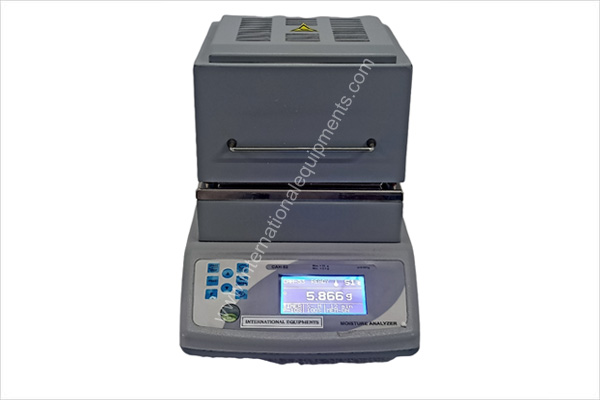
Digital Moisture Analyser

Specifications Table

ParameterSpecification
Capacity0 - 50 gms
Resolution0.001 gms
Pan Size100 mm
Response Time4 to 6 sec
Power Supply230 V, 50 Hz, Single Phase
Moisture Content Resolution0.1 %
Moisture Content Accuracy± 0.5 %
HeatingBy infrared halogen tube heater
Weighing TechnologyEMFC
Temperature RangeUp to 200° C
Temperature Resolution1° C
DisplayLCD for time, temperature, weight & % moisture
Data StorageUp to 50 tests
PC InterfaceRS 232 interface for computer

* Specifications kept exactly as published on the existing website.

What is a Digital Moisture Analyser?

A Digital Moisture Analyser is a precision laboratory instrument that determines the moisture content of a small sample (typically 1 to 50 grams) by the loss-on-drying method. The instrument combines a precision built-in weighing balance with a controlled-temperature heating chamber - typically a halogen-lamp or infrared heater positioned directly above the weighing pan. The operator places the sample on the pan; the instrument records the starting weight, then heats the sample at a controlled temperature (typically 100°C to 160°C for plastics) until all moisture has evaporated. The moisture content is calculated as the percentage weight loss and displayed directly.

Different from a conventional Hot Air Oven (which heats samples at controlled temperature but does not measure weight loss in real time), the Moisture Analyser performs the entire test in a single self-contained instrument - typically completing a moisture-content measurement in 5 to 20 minutes versus 2 to 4 hours for the oven method. This speed advantage makes the Moisture Analyser essential for incoming-material QC and production-line moisture monitoring where rapid turnaround is critical to avoid extruder downtime.

About Our Digital Moisture Apparatus

Our Digital Moisture Analyser is built around a precision EMFC (Electromagnetic Force Compensation) weighing balance - the same high-accuracy weighing technology used in laboratory analytical balances. EMFC weighing gives 0.001 gram (1 milligram) resolution across the full 0-60 gram capacity range, with a fast 4-6 second weighing response time.

Heating is by infrared halogen tube heater - a fast, efficient, uniform heating method that brings the sample up to test temperature within seconds. The temperature is controllable up to 200°C with 1°C resolution, covering the full range needed for moisture analysis of plastics (typically 100-160°C), food samples (105-130°C) and agricultural products. The 100 mm pan size accommodates typical sample sizes (1-50 grams).

Moisture content is measured with 0.1% resolution and ±0.5% accuracy. The bright LCD display shows live time, temperature, weight and percentage moisture readings throughout the test. Internal memory stores up to 50 test results for batch tracking; an RS-232 serial interface allows direct connection to a PC for full data logging and LIMS integration.

The instrument runs on standard 230 V / 50 Hz single-phase power. The compact bench-top design takes minimal lab space; powder-coated finish for long laboratory service life.

Why Moisture Testing is Critical

  • Prevents Hydrolytic Degradation of Engineering Polymers
    PA (Nylon), PC, PBT, PET and other condensation polymers undergo hydrolytic degradation when processed with excess moisture - permanently reducing molecular weight and mechanical properties.
  • Eliminates Surface Defects (Splay, Bubbles, Voids)
    Even moderately wet granules produce silver streaks, bubbles, voids and surface roughness that make parts unsellable.
  • Catches Wet Granules After Storage or Shipping
    Even properly-dried granules absorb atmospheric moisture during storage and transfer, particularly during monsoon months.
  • Required Documentation for Engineering Polymer Customers
    Automotive, electrical and medical-device customers routinely require documented incoming-material moisture verification.
  • Speed Advantage Over the Oven Method
    The Moisture Analyser completes a measurement in 5-20 minutes versus 2-4 hours for the oven method.
  • Essential for Food, Pharma and Agricultural QC
    Moisture content is a fundamental QC parameter across food, pharma and agricultural produce, using the same instrument.

How the Halogen-Lamp Method Works

  • Step 1 - Tare the Empty Pan
    The instrument zeros the empty pan weight so the subsequent measurement reads only the sample weight.
  • Step 2 - Place a Representative Sample on the Pan
    Add 2-10 grams of granules or powder, spread evenly across the pan for uniform drying.
  • Step 3 - Select the Test Temperature and Start
    Set the test temperature appropriate for the material (typically 105°C or 160°C) and start the test.
  • Step 4 - Continuously Monitor Weight Loss
    The instrument continuously weighs the sample and computes percentage weight loss in real time on the LCD.
  • Step 5 - Test Ends Automatically When Weight Stabilises
    The final moisture content is displayed, stored, and can be transmitted to a PC via RS-232.

Hygroscopic Polymers That Must Be Moisture-Tested

  • Polyamide (PA / Nylon 6, Nylon 66, Nylon 12)
    The most hygroscopic engineering polymer - can absorb 2-10% atmospheric moisture. Required maximum before moulding is typically 0.2% or lower.
  • Polycarbonate (PC) and PC Blends
    Highly susceptible to hydrolytic degradation. Required maximum moisture is typically 0.02%.
  • Polyethylene Terephthalate (PET / PETG)
    Required maximum moisture typically 0.005% for bottle-grade applications.
  • Polybutylene Terephthalate (PBT)
    Engineering polymer for electrical/automotive; required maximum moisture typically 0.04%.
  • ABS, SAN, PMMA, TPU, PEEK
    Moderately to highly moisture-sensitive - maximum moisture typically 0.02% to 0.2% depending on grade.

Moisture Analyser vs Hot Air Oven - Which Do I Need?

  • Moisture Analyser (This Product) - Fast Single-Sample Measurement
    Self-contained instrument completing a measurement in 5-20 minutes per sample. Best for incoming-material QC and production-line monitoring.
  • Hot Air Oven - Multi-Sample Batch Drying & Long-Duration Testing
    Larger oven (ambient to 250°C) holding multiple sample dishes for the conventional oven method, accelerated ageing and film shrinkage testing. See Hot Air Oven.
  • Do I Need Both?
    Most well-equipped polymer QC labs have both - the Moisture Analyser for fast incoming-batch QC, and the Hot Air Oven for parallel multi-sample drying and ageing studies.

Technical Information

  • ASTM D 6980 - Standard Test Method for Determination of Moisture in Plastics by Loss in Weight (the primary plastic-industry standard)
  • ASTM D 570 - Standard Test Method for Water Absorption of Plastics
  • ASTM E 203 - Standard Test Method for Water Using Volumetric Karl Fischer Titration
  • ISO 15512 - Plastics - Determination of Water Content
  • ISO 62 - Plastics - Determination of Water Absorption
  • IS 2828 - Methods of test for plastics (moisture-related clauses)
  • BS 2782 Method 430A - British Standard for plastic moisture determination
  • USP <731> - United States Pharmacopeia Loss on Drying method
  • AOAC 925.10 - Official Methods of Analysis for moisture content
  • Moisture content QC of incoming polymer granules before extrusion or moulding
  • Moisture verification of dried granules after silo / hopper drying
  • Incoming-material QC of hygroscopic engineering polymers (PA, PC, PET, PBT, ABS, SAN, PMMA, TPU, PEEK)
  • Moisture monitoring of master-batch and compounded grades
  • Recycled polymer moisture re-verification before re-processing
  • Moisture content of cellulose ether and powder additives in tile adhesives
  • Moisture content of pharmaceutical powders per USP <731>
  • Food and agricultural product moisture content (grain, seed, spice, flour, dairy powder)
  • Moisture content of textiles and yarn before processing
  • Process drying validation and dryer-performance monitoring
  • QC documentation for engineering-plastic component customers
  • Failure-investigation testing when surface defects appear in mouldings
  • Plastic Processors & Injection Moulders (especially engineering plastics)
  • Plastic Extruders (film, sheet, pipe, profile)
  • Polymer Producers, Compounders & Master-batch Manufacturers
  • Engineering Plastic Component Manufacturers
  • Recycled Plastic Compounders & Processors
  • Automotive Component Manufacturers
  • Electrical & Electronic Component Manufacturers
  • Pharmaceutical & Medical Device Manufacturers
  • Food Processing & Agricultural Companies
  • Tile Adhesive & Construction Chemical Manufacturers
  • Yarn, Fibre & Textile Manufacturers
  • Government Testing Labs, NABL Accredited Labs & BIS-Approved Test Houses
  • R&D Centres of Polymer, Plastic, Food and Pharmaceutical Companies
  • Precision EMFC Weighing Technology
    0.001 gram resolution and reliable accuracy for low moisture content measurements.
  • Fast Infrared Halogen Heating
    Brings the sample to test temperature within seconds, versus minutes for a conventional oven.
  • Wide Temperature Range up to 200°C
    Covers plastics, food/pharma and high-temperature stable materials with 1°C resolution.
  • Comprehensive Display & Data Storage
    Bright LCD, 50-test internal memory, RS-232 PC interface for data logging.
  • Fast 4-6 Second Weighing Response
    Captures the moisture-loss curve in real time without lag.
  • Versatile - Plastics, Food, Pharma, Agriculture
    Same instrument supports moisture analysis across many material types.
  • ISO Certified, CE Marked Manufacturing
    Built at our Mumbai facility under ISO certified quality systems, CE marked for export.
  • Free Installation, Training & Calibration
    Free on-site installation, operator training and factory calibration certificates.

FAQs

Both can measure moisture content via loss-on-drying, but they suit different operational needs. A Moisture Analyser is a self-contained instrument combining heating, weighing and display - measures one sample at a time but completes the test in 5-20 minutes. A Hot Air Oven is a larger temperature-controlled chamber holding multiple sample dishes, used with a separate analytical balance for the conventional oven method, taking 2-4 hours per batch. Most well-equipped polymer QC labs have both.
Per ASTM D 6980, the typical recommended temperatures are: 105°C for most general-purpose plastic granules (PE, PP, PS, ABS); 160°C for faster drying of stable engineering polymers (PA, PC, PBT, PET); slightly lower temperatures for thermally-sensitive polymers like LDPE. The polymer datasheet typically specifies the recommended drying temperature.
Typical maximum moisture specifications: PET - 0.005%; PC - 0.02%; PEEK - 0.02%; PBT - 0.04%; PMMA - 0.04-0.1%; TPU - 0.05%; PA/Nylon - 0.2%; ABS - 0.1-0.2%; SAN - 0.1%. Always refer to the specific polymer grade datasheet for the exact specification.
EMFC stands for Electromagnetic Force Compensation - a high-accuracy weighing technology that uses an electromagnetic coil to balance the gravitational force on the sample. EMFC is the same weighing technology used in laboratory analytical balances and is significantly more accurate than strain-gauge load cells for moisture analysis where content may be only 0.1-0.5%.
Typical ranges: dry polymer granules at 105°C - 3-5 minutes; moderately wet engineering plastic at 160°C - 5-10 minutes; very wet or thermally-sensitive material - 15-25 minutes. The instrument automatically ends the test when weight stabilises, generally far faster than the conventional oven method (2-4 hours).
Yes - the instrument supports moisture analysis of food samples, agricultural products, pharmaceutical powders per USP <731>, and chemical powders. Just adjust the test temperature appropriately (typically 105-130°C for food/pharma) and select an appropriate sample size.
Yes - the hopper dryer dries the granules, but it does not VERIFY that the granules have actually reached the required moisture level. Dryer performance can drift due to filter clogging, desiccant degradation or ambient humidity changes. The Moisture Analyser is the verification instrument that confirms the dryer is doing its job.
Yes. We provide free on-line installation, operator training on the moisture-analysis methodology (sample preparation, temperature selection, interpretation of the drying curve, calibration verification), and factory calibration certificate for both the weighing balance and the temperature controller. Annual calibration visit on chargeable basis will be done after 1 year.

Need reliable moisture testing for your polymer, plastic, food or pharma QC laboratory?

Contact International Equipments today for a personalised quotation on the Digital Moisture Analyser. Tell us your typical material (polymer granules, food, pharma powder), the moisture spec you need to verify and your testing volume - our team will share pricing, delivery timeline and the list of leading manufacturers already using our Moisture Analysers.

Get Free Quote