Quote Request
Quote
Manufacturers and Suppliers of Charpy Impact Tester / Izod Impact Tester

Digital Density Apparatus — Specific Gravity Method Manufacturer in India

Digital Density Apparatus (Specific Gravity Method) Based On Digital Weighing Balance.

International Equipments is a leading manufacturer, supplier and exporter of Digital Density Apparatus in India. Built at our Mumbai facility, our Digital Density Apparatus uses the internationally accepted Specific Gravity Method (Archimedes principle) on a precision digital weighing balance — giving fast, accurate and repeatable density measurement of plastic granules, polymer pellets, rubber, foam, film cuttings, ceramics, glass and most solid laboratory samples.

Density is one of the most fundamental and frequently tested properties in the plastic, polymer, recycled plastic and packaging industries. It is used for raw material grade verification, batch-to-batch consistency checking, recycled plastic acceptance, identification of unknown polymers, and as an essential input to MFI-to-MVR conversion calculations. Our Digital Density Apparatus delivers this critical measurement at lab-grade accuracy (1 mg resolution on a 220 g balance) at a price point accessible to every QC laboratory.
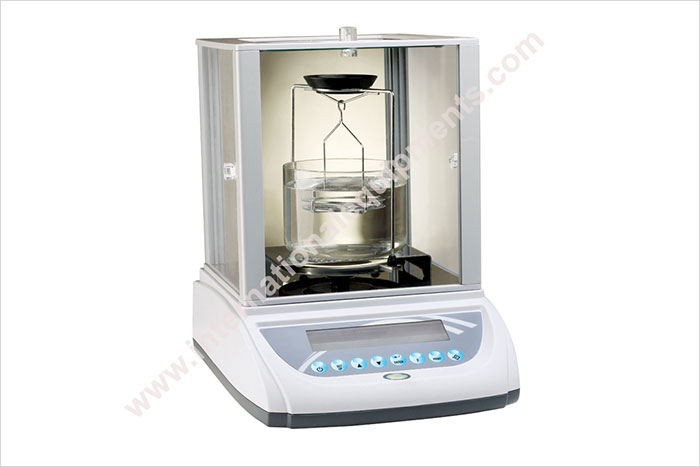
Digital Density Apparatus Manufacturer India — Specific Gravity Method on 220g 1mg Digital Weighing Balance by International Equipments

Specifications at a Glance

Parameter Specification
Test Method Specific Gravity Method (Archimedes Principle)
Weighing Balance Range 220 grams
Resolution 1 milligram (0.001 g)
Accessories Supplied Beaker, Stand, Sinker and Thread
Paint Finish Powder coated
Power Requirement 230 Volts, 50 Hz, single phase

What is a Digital Density Apparatus?

A Digital Density Apparatus — also called a Specific Gravity Tester, Density Balance or Hydrostatic Weighing Balance — is a precision laboratory instrument that measures the density of a solid sample using the Archimedes principle of buoyancy. The sample is first weighed in air on a digital balance, then weighed again while immersed in a liquid of known density (typically distilled water). The difference between the two weights, combined with the known density of the liquid, gives the density of the sample directly in grams per cubic centimetre (g/cc).

The Specific Gravity Method built into our apparatus is the international reference method specified by ASTM D 792, ISO 1183 and the relevant Indian Standards for measuring the density of plastics, polymers, recycled plastic and most solid materials. It is faster, simpler and more accurate than older displacement-volume methods, and requires no calibration of complex pycnometers — only the routine calibration of the digital balance itself.

About Our Digital Density Apparatus

Our Digital Density Apparatus is built around a precision 220 g digital weighing balance with 1 mg (0.001 g) resolution — the standard combination specified by ASTM D 792 for plastic and polymer density testing. The apparatus is supplied complete with a calibrated beaker, a precision stand, a stainless-steel sinker (for samples that float) and a fine thread for suspending the sample below the balance pan during underwater weighing.

The complete workflow takes less than two minutes per sample: place the sample on the pan and read the dry weight, then transfer it to the suspended sample basket immersed in water and read the wet weight. The density calculation — Dry Weight / (Dry Weight − Wet Weight) × Water Density — gives the result directly in g/cc. With the supplied sinker, the apparatus easily handles low-density samples such as LDPE film, foam and certain recycled grades that would otherwise float.

Compared to costly automated electronic density meters, our manual specific-gravity setup gives the same result accuracy at a fraction of the price, with no consumables and minimal training required — making it the standard density solution for QC labs across the polymer, plastic pipe, recycled plastic, film and packaging industries in India and abroad.

How the Specific Gravity Method Works

The Specific Gravity Method is based on Archimedes' principle: when a solid is fully immersed in a liquid, it experiences an upward buoyant force equal to the weight of the liquid it displaces. By measuring the sample weight in air and again under water, the density of the sample can be calculated precisely.

Step 1 — Weigh in Air (Dry Weight)

Place the dry, clean sample directly on the balance pan and record the weight (W₁) in grams to 1 mg resolution. This is the true mass of the sample.

Step 2 — Weigh Immersed in Water (Wet Weight)

Suspend the sample in the supplied beaker of distilled water using the thread, ensuring the sample is fully submerged and no air bubbles cling to the surface. Read the apparent weight in water (W₂). For low-density samples that float, the stainless-steel sinker is attached to keep the sample submerged.

Step 3 — Calculate Density Directly

Density (g/cc) = W₁ / (W₁ − W₂) × ρ_water, where ρ_water is the density of water at the test temperature (effectively 1.00 g/cc at 20–25°C). The result is the specific gravity of the sample, directly comparable with material specification sheets and ASTM/ISO standard reference values.

Technical Specifications

Parameter Specification
Test Method Specific Gravity Method (Archimedes Principle)
Weighing Balance Range 220 grams
Resolution 1 milligram (0.001 g)
Accessories Supplied Beaker, Stand, Sinker and Thread
Paint Finish Powder coated
Power Requirement 230 Volts, 50 Hz, single phase

Accessories Supplied

Each Digital Density Apparatus is supplied complete with the full accessory set required to perform the test from day one — no separate sourcing needed:

Digital Weighing Balance

Precision 220 g capacity balance with 1 mg resolution, the core measurement instrument of the apparatus.

Beaker

Calibrated glass beaker that holds the distilled water in which the sample is suspended during wet weighing.

Stand

Sturdy stand that holds the beaker steady at the correct height below the balance pan, ensuring the sample hangs freely in the water without touching the beaker walls.

Sinker

Stainless-steel sinker for use with low-density samples that float in water (LDPE, certain foams, low-density recycled grades) — keeps the sample submerged for accurate wet-weight reading.

Thread

Fine, low-water-absorption thread used to suspend the sample below the balance pan into the water beaker.

Why Density Measurement Matters in the Plastic Industry

Density is one of the most informative and most frequently tested properties in the plastic and polymer industry. Here are the main reasons every polymer QC lab needs an accurate density apparatus:

Polymer Grade Identification

Different polymers have characteristic density ranges — LDPE typically 0.910–0.925 g/cc, HDPE 0.940–0.965 g/cc, PP 0.895–0.905 g/cc, PVC 1.35–1.45 g/cc. Density measurement is the fastest way to confirm that incoming material is the grade you ordered, and to flag any contamination or wrong-grade shipment before it enters production.

Batch Consistency Checking

Even within a single polymer grade, density can vary by a few thousandths of a g/cc between batches. Monitoring this on every incoming batch catches process drift in the supplier's plant and prevents downstream moulding or extrusion defects.

Recycled Plastic Verification

Recycled plastic shipments often contain contamination from other polymer types — recycled HDPE may have PP or PET mixed in. Density measurement on a representative sample is the simplest first-line check that recycled material meets the required specification.

MFI to MVR Conversion

When converting Melt Flow Rate (MFR, in g/10 min) to Melt Volume Rate (MVR, in cu.cm/10 min) using your MFI Tester data, the melt density of the polymer is an essential input. The room-temperature density measured on the Density Apparatus provides the baseline value.

Filled & Compounded Polymers

When a polymer is compounded with mineral fillers (talc, calcium carbonate), glass fibres or carbon black, the density rises in proportion to the filler content. Density measurement is the standard quality check that the filler loading is correct in the compounded product.

Foam & Cellular Plastic Density

Foam products (EPS, XPS, PU foam) are sold and specified by density. Apparent density measurement using the Specific Gravity Method (with the supplied sinker) is the standard test for these products.

Test Standards Supported

  • ASTM D 792 — Standard Test Methods for Density and Specific Gravity (Relative Density) of Plastics by Displacement
  • ISO 1183-1 — Plastics: Methods for determining the density of non-cellular plastics — Part 1: Immersion method, liquid pyknometer method and titration method
  • ISO 1183-2 — Density gradient column method
  • IS 13360 (Part 3/Sec 3) — Indian Standard for density of plastics by displacement
  • IS 7016 — Indian Standard for density of coated fabrics
  • ASTM D 1505 — Standard Test Method for Density of Plastics by the Density-Gradient Technique

Applications of Digital Density Apparatus

  • Density measurement of HDPE, LDPE, LLDPE, PP, PVC, ABS, PS, PC, Nylon and other polymer granules
  • Specific gravity testing of finished plastic products — pipes, bottles, crates, mouldings
  • Density verification of recycled plastic before re-extrusion
  • Density check of carbon-black-filled and mineral-filled compounded polymers
  • Apparent density measurement of foam and cellular plastics (EPS, XPS, PU foam)
  • Density testing of rubber, TPE and elastomer compounds
  • Density measurement of film cuttings and plastic sheet samples
  • Specific gravity of fibre, yarn and woven fabric samples
  • Density of ceramic tiles, mosaics and ceramic raw materials
  • Polymer grade identification and contamination screening
  • Input data for MFI-to-MVR conversion calculations
  • QC documentation for ISO 9001 and NABL audits

Industries We Serve

  • Plastic Pipe Manufacturers (HDPE, PPR, PVC, PEX)
  • Plastic Film & Flexible Packaging Industry
  • Polymer Producers and Master-batch Compounders
  • Recycled Plastic Processors
  • Rubber, TPE & Elastomer Producers
  • Blow-Moulded Container & Bottle Manufacturers
  • Injection Moulded Plastic Product Manufacturers
  • EPS, XPS and PU Foam Producers
  • Carbon Black & Mineral Filler Compounders
  • HDPE PLB Duct Manufacturers
  • Ceramic Tile, Mosaic & Ceramic Raw Material Producers
  • Government Testing Labs, NABL Labs & Universities
  • Polytechnic Colleges & ITI Institutes

Why Choose International Equipments?

  • Industry-Standard 220 g / 1 mg Specification
    The 220 g capacity and 1 mg resolution match the exact ASTM D 792 specification for plastic and polymer density testing — directly comparable with any other ASTM-compliant lab worldwide.
  • Complete Accessory Set Included
    Calibrated beaker, sturdy stand, stainless-steel sinker (for floating samples) and fine suspension thread — everything needed to run the test from day one.
  • Handles Floating Samples Too
    The supplied stainless-steel sinker makes the apparatus equally suitable for low-density samples like LDPE film, foam and recycled grades that would otherwise float on water.
  • Fast Two-Minute Test
    Complete dry-and-wet weighing cycle takes less than two minutes per sample — ideal for high-throughput QC labs that test every incoming batch.
  • No Consumables, No Calibration Standards
    Unlike pycnometer methods or electronic density meters, the Specific Gravity Method needs only distilled water — no consumables, no expensive reference fluids, no recurring calibration costs.
  • Compact Bench-Top Footprint
    Fits easily on any standard lab bench alongside an MFI Tester, UTM controller or other QC equipment.
  • ISO & CE Certified Manufacturing
    Designed and built at our Mumbai facility under ISO certified quality systems, with CE marking for export to the Middle East, Africa, South-East Asia, Europe and South America.
  • Calibration Support
    We offer one calibration visit per year, which is sufficient to maintain the accuracy and performance of the equipment. The calibration visit is provided after completion of the initial 1-year warranty period.

Frequently Asked Questions

The method is based on Archimedes' principle. The sample is weighed once in air (dry weight) and once while fully immersed in water (wet weight). The difference between the two weights equals the weight of water the sample displaced, which corresponds directly to the volume of the sample. Density is then calculated as Dry Weight divided by (Dry Weight minus Wet Weight), multiplied by the density of water (effectively 1.0 g/cc at room temperature). The result is in g/cc, the standard density unit used for polymer specifications.
Some samples — LDPE film, foam, low-density recycled plastics — have densities below 1.0 g/cc and naturally float on water, making it impossible to weigh them immersed. The supplied stainless-steel sinker is attached to the sample, forcing it underwater so the wet weight can be read. The sinker's own weight in water is subtracted in the calculation, leaving the true sample density. With the sinker, our Density Apparatus handles every common plastic and foam sample.
ASTM D 792 specifies a balance with at least 1 mg accuracy. The 220 g range is the standard capacity for ASTM-compliant plastic density testing — large enough for typical polymer granule, pellet, film and small-product samples, with the resolution that gives meaningful density readings to four decimal places (e.g., 0.9540 g/cc). This combination is the global standard for plastic and polymer QC.
Distilled water at room temperature is the standard immersion liquid for plastics, polymers, rubber and most solid samples — ASTM D 792 specifies water as the default. For samples that absorb water, or for samples with density very close to water (around 1.0 g/cc), the standard also allows isopropyl alcohol or other low-density organic liquids. The same procedure applies; only the liquid's density value changes in the calculation.
Less than two minutes per sample. Step 1 — weigh the dry sample on the pan (about 30 seconds for the reading to stabilise). Step 2 — transfer to the suspension thread, immerse in water, take the wet weight (about 30–45 seconds). Step 3 — calculate the result. This makes the apparatus suitable for high-throughput QC labs that need to test every incoming batch of polymer granules.
Almost any solid sample that does not dissolve in water — plastic granules, polymer pellets, finished plastic products (pipes, bottles, crates, mouldings), rubber, TPE, foam (with sinker), film cuttings, fibre, yarn, fabric, ceramic tiles, ceramic raw materials, and most engineering materials. Powdered samples that disperse in water are not suitable for this method — they require pycnometer techniques instead.
Yes. Every Digital Density Apparatus is supplied with a factory calibration certificate for the 220 g / 1 mg digital weighing balance. Periodic recalibration through our service network is available. We can also coordinate NABL-traceable calibration if your QC documentation requires it.
Yes. We provide free on-site installation, commissioning, operator training on the Specific Gravity Method procedure, and a factory calibration certificate at the customer's location anywhere in India. The apparatus is straightforward to set up and operate, but on-site training ensures the operator follows the correct procedure (especially the handling of bubble-free immersion, which is the most common source of operator error). Annual Maintenance Contracts (AMC) and recalibration are available through our service network. International customers receive commissioning support remotely with detailed documentation.

Need a reliable Digital Density Apparatus for plastic, polymer, recycled plastic or general material density QC?

Contact International Equipments today for a personalised quotation. Our team will share pricing, delivery timeline, the demo video and the list of leading polymer and pipe manufacturers already using our Density Apparatus.

Get Free Quote