Request
Quote

| Parameter | Specification |
|---|---|
| Height of Fall | 500 mm, 1000 mm and 2000 mm (three calibrated positions) |
| Weight of Striker | 250 grams, 500 grams and 1000 grams (three calibrated strikers) |
| Material of Striker | S.S. (Stainless Steel) |
| Angle of V-Block | 120° (per IS 4985 / IS 12235 (Part 9) specification) |
| Release Mechanism | Manual |
| Paint Finish | Powder coated |
| Primary Application | Drop-weight impact testing of plastic pipes per IS 4985 and IS 12235 (Part 9) |
International Equipments is a leading manufacturer, supplier and exporter of Drop-Weight Impact Testers for Pipes in India. Built at our Mumbai facility, our Impact Tester is a precision laboratory instrument that drops a calibrated striker weight onto a pipe sample from a controlled height — directly simulating the real-world impact loading a plastic pipe experiences during installation, transportation and accidental knocks in service. The test is performed strictly as per IS 4985 (uPVC water pipes) and IS 12235 (Part 9) — the central Indian Standards for low-temperature impact testing of plastic water pipes.
Drop-weight impact testing is one of the four core QC tests for any pressure-rated plastic pipe (along with Hydrostatic Pressure, Carbon Black Content/Dispersion and Tensile testing). It directly answers the question: 'Can this pipe withstand impact loading without cracking?' A pipe that fails the impact test will crack from accidental knocks during construction or installation; a pipe that passes survives these real-world hazards. The Impact Tester for Pipes is the instrument that delivers this critical pass-fail measurement — mandatory for ISI mark certification of every HDPE, PVC, CPVC and PLB telecom duct produced for sale in India.
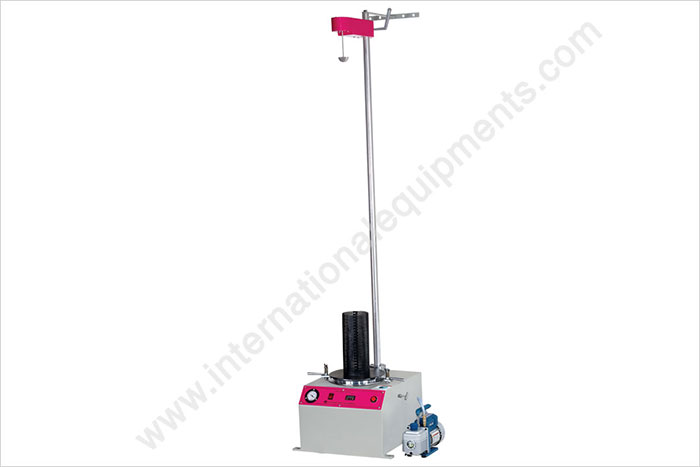
A Drop-Weight Impact Tester — also called a Falling-Weight Impact Tester, Tup Impact Tester or simply Pipe Impact Tester — is a vertical drop-tower instrument that releases a calibrated weight (the 'striker' or 'tup') from a specified height onto a pipe sample resting on a V-block support. The striker accelerates under gravity and strikes the pipe with a precisely-defined impact energy (energy = mass × gravity × height). The operator observes whether the pipe cracks, splits or remains intact after the impact, then records the result against the pass/fail criterion specified by the relevant standard.
Pipe impact testing is fundamentally different from notched-bar pendulum impact testing (Izod, Charpy). The drop-weight test applies impact to a WHOLE PIPE sample in its as-supplied form — directly simulating the real-world failure mode that occurs when pipes are dropped, struck or knocked during installation. Notched-bar Izod/Charpy testing applies pendulum impact to a small notched specimen cut from the pipe wall — giving a material-property toughness value rather than a whole-pipe pass/fail. Both tests are useful; the IS 4985 and IS 12235 (Part 9) standards specifically require the drop-weight whole-pipe approach.
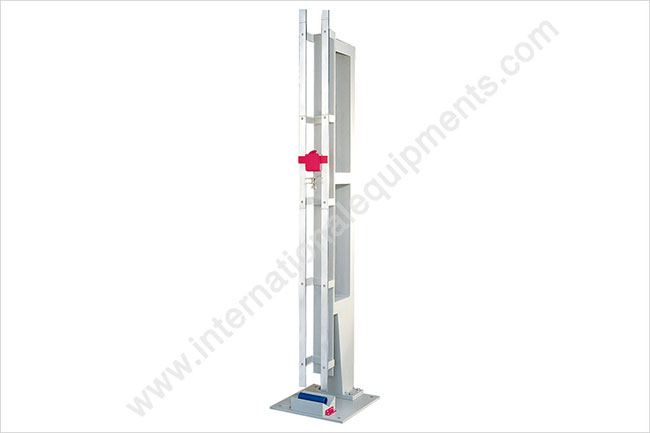
Our Impact Tester for Pipes is a free-standing drop-tower instrument designed specifically for the IS 4985 / IS 12235 (Part 9) drop-weight pipe impact test. The drop height is selectable from three calibrated positions — 500 mm, 1000 mm and 2000 mm — covering the impact energy range specified by the standard for different pipe diameter and wall thickness classes. The taller 2000 mm drop is used for thicker-walled pipes that need higher impact energy to verify their impact resistance.
Three stainless-steel striker weights are supplied — 250 grams, 500 grams and 1000 grams — giving the operator a wide range of impact energies to match the specific pipe being tested. Striker construction is stainless steel for corrosion resistance and dimensional stability over years of high-volume daily QC use. Combining the three drop heights with the three striker weights gives 9 different calibrated impact energy combinations — covering virtually every pipe specification in the Indian, ISO and ASTM ranges.
The pipe sample rests on a V-block support with a 120° included angle — the standard sample-support geometry specified by IS 4985 and IS 12235 (Part 9). The 120° angle holds the pipe sample stably without crushing or deforming it, while leaving the upper pipe surface exposed for direct striker impact. The manual release mechanism gives the operator full control over the test cycle — load pipe, release striker, observe result, record pass/fail. Heavy-duty M.S. construction with powder-coated finish for long lab service life.
for pipes as per IS 4985 and IS 12235 (Part 9) to test the impact strength of the pipes.
Drop-weight impact testing is mandatory under Indian Standards for any plastic pipe certified for ISI mark. Five reasons every plastic pipe manufacturer needs in-house impact testing capability:
BIS certification for ISI mark on uPVC water pipes (IS 4985), HDPE water pipes (IS 4984), HDPE sewerage pipes (IS 14333) and HDPE PLB ducts (IS 14930) all require the manufacturer to demonstrate in-house impact testing capability. Without the Impact Tester in the lab, ISI mark cannot be retained — and without ISI mark, the pipe cannot be sold for most government and certified-private projects in India.
Plastic pipes become more brittle at low temperatures. IS 4985 and IS 12235 (Part 9) specify impact testing at 0°C — pre-conditioning the pipe in a Zero Degree Chamber, then performing the drop-weight test within seconds of removal. This worst-case-temperature approach demonstrates the pipe will survive winter installation conditions across India.
Impact resistance is one of the most sensitive QC indicators of polymer batch variation. Subtle changes in molecular weight, impact modifier content or processing conditions show up as impact failures long before they show up as tensile or hydrostatic problems. Periodic impact testing on production-line samples catches this drift early — preventing field-failure problems that would otherwise hit months after the bad batch was shipped.
Most government and municipal water-supply and telecom infrastructure tenders explicitly require impact test reports along with the dispatch documentation. Without these reports, tender payments and project clearances are delayed indefinitely — a real cash-flow problem for the manufacturer.
Department of Telecom (DOT) specifications for HDPE PLB telecom duct used in BSNL, BharatNet, Reliance Jio, Airtel and government telecom infrastructure projects explicitly require low-temperature impact testing. Without documented impact test reports, PLB duct cannot be supplied to most telecom infrastructure tenders.
The complete IS 4985 / IS 12235 (Part 9) pipe impact test is a 5-step procedure spanning two instruments — the Zero Degree Chamber for pre-conditioning and the Impact Tester for the actual impact:
Cut a length of pipe to the standard test sample length (typically 200 mm / 8 inches for IS 4985 / IS 12235 (Part 9)). The sample must be free of moulding defects, scratches or surface flaws that could falsely initiate cracks. Mark the impact point on the pipe (typically the centre of the sample length, at the 12 o'clock position when resting on the V-block).
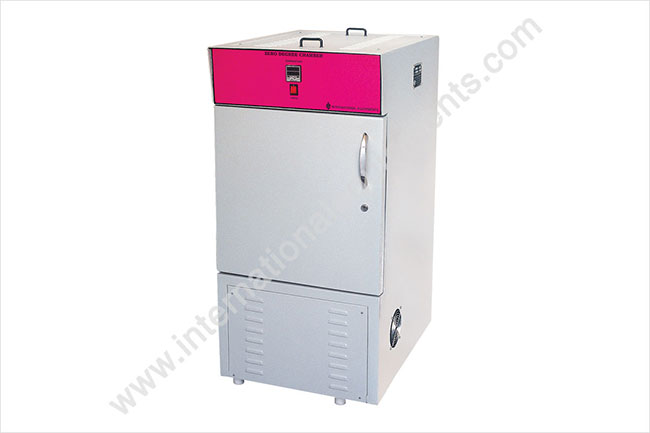
Place the prepared pipe sample in the Zero Degree Chamber set to 0°C. Hold for the conditioning time specified by the standard for the pipe wall thickness (typically 1-4 hours — longer for thicker walls). Multiple samples can be conditioned simultaneously for high-throughput testing.
Determine the impact energy required by the applicable IS standard for the specific pipe being tested (impact energy depends on pipe diameter, wall thickness and material). Select the appropriate combination of striker weight (250 / 500 / 1000 grams) and drop height (500 / 1000 / 2000 mm) to deliver that energy. Load the chosen striker into the drop mechanism at the chosen height.
Remove the conditioned pipe sample from the Zero Degree Chamber and IMMEDIATELY place it on the 120° V-block of the Impact Tester. Within 5-10 seconds of removal from the chamber, release the striker manually. The striker accelerates under gravity and strikes the pipe at the predetermined energy. Speed of transfer is critical — the sample begins warming above 0°C the moment it leaves the chamber.
Carefully inspect the impact zone for cracks, splits or any other damage. Some standards count the test as 'pass' if the pipe is undamaged after a specified number of impacts; others use the 'staircase method' to determine the impact energy at which 50% of specimens fail. Record the result against the IS 4985 / IS 12235 (Part 9) pass/fail criterion. For comprehensive QC, test multiple samples and report the percentage that pass.
The Impact Tester for Pipes is the second half of the IS 4985 / IS 12235 (Part 9) low-temperature pipe impact test workflow. The first half is the Zero Degree Chamber — the refrigerated pre-conditioning chamber that holds the pipe sample at exactly 0°C before the impact test:
The Zero Degree Chamber pre-conditions the pipe sample at exactly 0°C for the specified time. The Impact Tester then drops a calibrated weight onto the conditioned sample from the specified height, recording whether the pipe cracks. The two instruments are commonly purchased together — many HDPE, PVC and PLB duct QC laboratories invest in the matched pair as a single quotation, with one commissioning visit, one training programme covering both methods.
We strongly recommend buying both instruments together if your laboratory does not already have a Zero Degree Chamber — running the IS 4985 / IS 12235 (Part 9) impact test requires both, and ordering them together typically gives better package pricing than purchasing them separately at different times. Position them adjacent to each other on the same lab bench to minimise the chamber-to-tester sample transfer time.
Drop-weight tester on a WHOLE PIPE sample. Tests the as-supplied finished pipe in its actual geometry. Specified by IS 4985 / IS 12235 (Part 9) for water pipes, IS 14930 for PLB duct. Pass/fail outcome based on whether the pipe cracks under defined impact energy. Test result directly predicts real-world impact survival.
Pendulum tester on a SMALL NOTCHED SPECIMEN cut from the pipe wall (or from any polymer sample). Test result is a material toughness value (J/m²) — a material-property measurement that can be compared between batches and against material specifications. Specified by ASTM D 256 and ISO 180. Better for material development and polymer-grade qualification.
Both tests serve different but complementary roles. Whole-pipe drop-weight (this product) is required for IS 4985 / IS 12235 / DOT certification. Notched-bar Izod/Charpy is required for polymer-grade qualification and material specifications. A well-equipped pipe QC lab typically has both instruments — we supply both, please discuss the matched-instrument package in your enquiry.
IS 4985 — Indian Standard for unplasticized PVC (uPVC) pipes for potable water supply (impact resistance clause)
IS 12235 (Part 9) — Methods of test for unplasticized PVC pipes — Impact resistance at 0°C
IS 4984 — Indian Standard for HDPE pipes for potable water supply (impact resistance clause)
IS 14333 — Indian Standard for HDPE pipes for sewerage system
IS 14930 — Indian Standard for HDPE corrugated pipes (telecom PLB duct)
IS 15778 — Indian Standard for CPVC pipes for hot and cold water supply
ISO 3127 — Thermoplastics pipes — Determination of resistance to external blows by the round-the-clock method
ASTM D 2444 — Standard Practice for Determination of the Impact Resistance of Thermoplastic Pipe and Fittings by Means of a Tup (Falling Weight)
DOT (Department of Telecom) Specifications — for HDPE PLB duct low-temperature impact testing
Drop-weight impact testing of uPVC water-supply pipes per IS 4985
Impact resistance testing of HDPE water-supply pipes per IS 4984
Impact testing of HDPE sewerage pipes per IS 14333
Impact testing of HDPE PLB telecom duct per IS 14930 and DOT specification
Impact testing of CPVC hot-water pipes per IS 15778
Low-temperature impact testing of PPR pipes at sub-ambient temperatures
QC verification of impact modifier loading in PVC pipe compounds
Verification of recycled-polymer pipe impact resistance before pipe extrusion
Validation of new pipe designs and new polymer grades (R&D)
ISI mark certification routine QC testing
Government tender dispatch documentation
BIS audit demonstration of in-house impact testing capability
HDPE Pipe Manufacturers (water supply, sewerage, irrigation, gas distribution)
uPVC & PVC Pipe Manufacturers (water supply, drainage, sewerage)
HDPE PLB Duct Manufacturers (telecom & power cable ducting)
CPVC Pipe Manufacturers (hot & cold water plumbing)
PPR Pipe Manufacturers (hot & cold water plumbing, HVAC)
Polymer & Master-batch Compounders (impact modifier evaluation)
Recycled Plastic Pipe Processors
Government Testing Labs, NABL Accredited Labs & BIS-Approved Test Houses
Telecom Infrastructure Companies (BSNL, BharatNet, Reliance Jio, Airtel)
Municipal & Government Water-Supply Departments (third-party verification)
R&D Centres of Plastic Pipe Manufacturers
Calibrated drop heights of 500 mm, 1000 mm and 2000 mm combined with calibrated striker weights of 250 g, 500 g and 1000 g give 9 different impact energy combinations — covers virtually every pipe specification in the IS, ISO and ASTM ranges without any need to purchase additional strikers.
S.S. striker construction is corrosion-resistant, dimensionally stable and maintains its impact face geometry through years of high-volume daily QC service. No re-machining or replacement needed under normal use.
Standard sample-support geometry specified by the central Indian Standards — holds the pipe sample stably without crushing or deforming it while leaving the upper surface exposed for direct striker impact.
The Zero Degree Chamber + Impact Tester for Pipes pair implements the complete IS 4985 / IS 12235 (Part 9) low-temperature pipe impact test workflow. We commonly supply the matched pair as a single quotation — please mention this in your enquiry for matched-pair pricing.
Tests the as-supplied finished pipe in its actual geometry — directly simulating the real-world failure mode that occurs when pipes are dropped, struck or knocked during installation. Different from and complementary to notched-bar Izod/Charpy testing.
Manual release gives the operator full control over the test cycle — load pipe, set position, release striker, observe result. Simpler, more economical and less prone to mechanical failure than motorised release systems for the routine pass/fail use case.
Our Impact Tester for Pipes is installed in many of India's largest HDPE water pipe, PVC water pipe, PLB telecom duct and CPVC pipe manufacturing plants — client list available on request, including BIS-certified ISI mark holders.
Designed and built at our Mumbai facility under ISO certified quality systems, with CE marking for export to the Middle East, Africa, South-East Asia, Europe and South America.
We offer one calibration visit per year, which is sufficient to maintain the accuracy and performance of the equipment. The calibration visit is provided after completion of the initial 1-year warranty period.
This Impact Tester is a drop-weight instrument that tests a WHOLE PIPE sample — the striker falls vertically onto the as-supplied finished pipe resting on a V-block. It directly simulates the impact loading a pipe experiences during construction. The Izod / Charpy Impact Tester is a pendulum instrument that tests a SMALL NOTCHED SPECIMEN cut from the pipe wall — it measures a material toughness value rather than a whole-pipe pass/fail. The two tests serve complementary roles: Drop-weight is required by IS 4985 / IS 12235 / IS 14930 / DOT for pipe certification; Izod/Charpy is required for material-grade qualification. Most well-equipped pipe QC labs need both.
Refer to the applicable Indian Standard for your specific pipe type — IS 4985 specifies different impact energies for different pipe diameter and wall-thickness classes, expressed as kg-m or Joules. To convert: energy in joules = striker mass (kg) × 9.81 × drop height (m). Combining our 250 g / 500 g / 1000 g strikers with 0.5 m / 1.0 m / 2.0 m drop heights gives impact energies from about 1.23 J (lightest combination: 250 g × 0.5 m) up to about 19.6 J (heaviest combination: 1000 g × 2.0 m) — covering essentially every IS pipe impact energy specification. Our team can help you select the right combination during commissioning training.
Plastics become significantly more brittle at low temperature. A PVC water pipe that passes impact at 25°C may shatter at 0°C from the same impact energy. Indian Standards specify 0°C precisely because it represents the worst-case service temperature for water pipes — pipes in northern India experience winter temperatures around 0°C, and the QC test must demonstrate the pipe survives impact at this worst-case condition. Without pre-conditioning at 0°C in a Zero Degree Chamber before the impact test, the test result does not predict real winter-service performance.
Yes. The Zero Degree Chamber is a separate product, sold separately. The Impact Tester alone gives you the drop-weight test capability, but to run the full IS 4985 / IS 12235 (Part 9) low-temperature pipe impact test, you ALSO need the Zero Degree Chamber for pre-conditioning the sample at 0°C. We commonly supply both instruments together as a matched-pair quotation with one commissioning visit.please ask for the package quotation in your enquiry.
Yes, the Impact Tester itself can perform tests at any ambient temperature — but the result will not satisfy IS 4985 / IS 12235 (Part 9), which explicitly require 0°C pre-conditioning. Room-temperature impact testing can be useful for R&D and material screening but does not give certifiable QC results. For ISI mark certification, BIS audit and government tender documentation, the 0°C pre-conditioning step is mandatory and a Zero Degree Chamber is required alongside the Impact Tester.
The 120° V-block supports pipe samples across a wide diameter range — typically from small-diameter plumbing pipes (around 20 mm OD) up to medium-diameter water pipes (around 200-300 mm OD), depending on the V-block size and clearance under the striker drop column. For very large diameter pipes (above 300 mm OD), a larger Impact Tester or alternative test method may be needed. Please share your typical pipe diameter range in the enquiry — we can confirm compatibility and discuss any custom sizing needed.
Both are drop-weight impact instruments but they test very different products. The Impact Tester for Pipes tests WHOLE PIPE samples (200 mm length, resting on a V-block) — drop-weight strikes the pipe surface. The Dart Impact Tester tests FLAT PLASTIC FILM samples (clamped horizontally, falling dart pierces through the film) — measures the dart weight at which 50% of samples fail. The two instruments are for completely different applications: pipe extruders need the Pipe Impact Tester; film extruders need the Dart Impact Tester. We supply both as separate products.
Yes. We provide free on-line installation, commissioning, operator training on the IS 4985 / IS 12235 (Part 9) pipe impact test procedure (including correct chamber-to-tester transfer technique and selection of the appropriate striker weight + drop height for different pipe classes) and factory calibration certificates for the three striker weights and three drop heights at the customer's location anywhere in India.
Contact International Equipments today for a personalised quotation, demo video, or factory visit. Our team is ready to help you choose the right MFI tester model for your laboratory.
Get Free Quote