Request
Quote

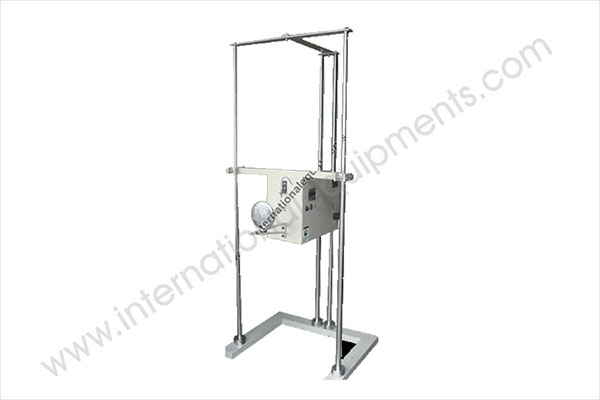
Our Back Punch Impact Tester is built around a 300 mm stroke pneumatic cylinder with a 40 mm cylinder bore — sized to generate the impact force and impact stroke specified by the standard plastic chair durability test methods. An electrically operated solenoid valve controls the piston's to-and-fro motion automatically, eliminating manual operator intervention during the multi-thousand-cycle test sequence. The standard impact weight is 3.2 kilograms, mounted on the piston end — this is the calibrated impact mass that strikes the chair backrest on each cycle.
The test frame is built on four hard-chrome-plated shafts of 1.5 metre vertical height — providing the rigid, dimensionally-stable support structure needed for repeated long-duration impact cycling. Hard chrome plating gives long-life corrosion resistance and a smooth, low-friction sliding surface for the impact-box assembly. The impact-box assembly (containing the pneumatic cylinder and solenoid valve) slides up and down the four shafts and can be locked at the desired height to match the specific chair design being tested — important because backrest impact point varies by chair geometry.
An electronic counter records the number of impact trials completed — essential for running standardised tests that require a defined number of cycles (e.g., 5,000 cycles or 10,000 cycles per applicable furniture durability standard). The counter accumulates cycle counts automatically across the entire test run without operator intervention. Compressed air for the pneumatic cylinder operation must be supplied by the customer's existing plant compressor — a standard industrial compressor delivering 5 to 10 kg/cm² is sufficient; compressor is not included with the tester.
Equipment is offered up to 50 KN (5,000 Kilogram) capacity.
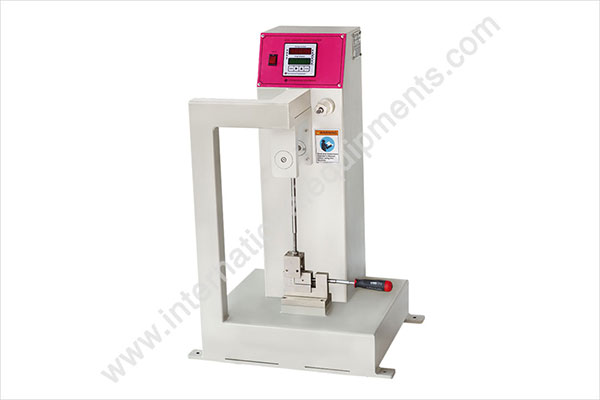
A Back Punch Impact Tester is a vertical pneumatic-cylinder test rig designed specifically to apply repeated impact loading to the backrest of a finished plastic chair. The chair is positioned on the test platform with its backrest facing a pneumatic piston that carries a calibrated impact weight; the piston is driven backward and forward by compressed air via a solenoid-actuated valve. On each cycle, the piston strikes the backrest with a defined energy, then retracts; a digital counter records the number of cycles completed. The test continues for a specified number of impacts (typically thousands of cycles, as defined by the applicable furniture standard) — the chair either survives intact (a pass) or fails by cracking, splitting or breaking at the backrest (a fail).
The fundamental purpose of the test is fatigue verification — most plastic chair backrest failures in service are not single-impact catastrophic failures but accumulated-damage fatigue failures after thousands of small impacts. A chair backrest that easily survives a single hard impact may still crack after 5,000 or 10,000 light impacts due to fatigue. Only a cyclic-impact test like the Back Punch can detect this fatigue behaviour before the chairs reach the customer. The instrument is the standard durability QC check in any well-equipped plastic chair / moulded furniture manufacturing plant.
Backrest fatigue testing is critical for any plastic chair manufacturer. Five reasons every moulded-chair production plant needs in-house Back Punch Impact Testing capability:
The Back Punch Impact Test is a straightforward but long-duration cycling test — typically 30 minutes to several hours per chair, depending on the number of cycles specified by the standard:
The Back Punch Impact Tester is one of two instruments commonly used together for complete plastic chair durability QC — the second being the Seat Impact Tester, which tests the seat (the horizontal surface) under repeated impact loading rather than the backrest:
Back Punch Impact Tester (this product) — tests the backrest of the chair under horizontal cyclic impact, simulating the lean-back, knock-against-back, push-against-back loading that occurs in normal chair use. Seat Impact Tester (separate product) — tests the seat surface under vertical drop impact, simulating the sit-down loading that occurs every time someone sits in the chair. Together, the two instruments cover the two principal cyclic loading modes on a plastic chair (vertical seat impact + horizontal backrest impact) — and together they make up the standard 'chair durability QC' setup recommended for any plastic moulded chair manufacturer. We commonly supply both as a matched-package quotation — one commissioning visit, one training programme and one AMC contract.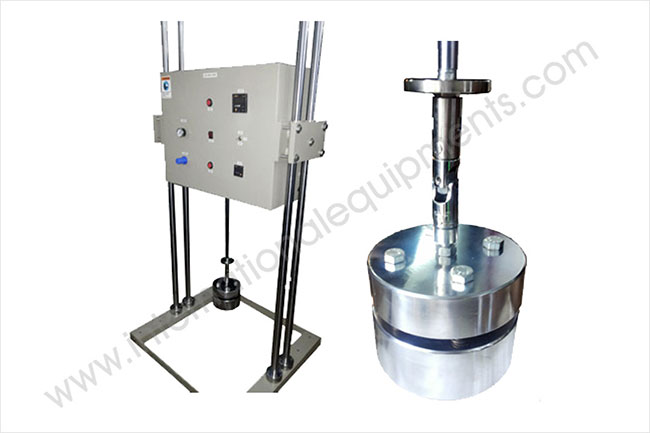
Contact International Equipments today for a personalised quotation. Tell us your chair type (school chair, office chair, stackable, public seating) and the test standards you follow (IS 4360, BIFMA X5.1, EN 1728, ISO 7173) — our team will share pricing, delivery timeline and the matched Back Punch + Seat Impact Tester package option for complete chair durability QC.
Get Free Quote