Quote Request
Quote
Manufacturers and Suppliers of Charpy Impact Tester / Izod Impact Tester

Computerised Hydrostatic Pressure Testing Equipment — HDPE PVC PPR CPVC Pipe Pressure Tester Manufacturer in India

About Computerised Hydrostatic Pressure Testing Equipment

Hydrostatic Pressure testing equipment is used for checking internal pressure in HDPE, PVC, PPR, CPVC pipes ranging between 16 mm diameter to 400 mm diameter. As per IS 4984 and IS 4985 to check the creep rupture of pipe when subjected to internal pressure under a specified condition.

International Equipments is a leading manufacturer, supplier and exporter of Computerised Hydrostatic Pressure Testing Equipment in India. Built at our Mumbai facility and exported to plastic pipe manufacturers across India, the Middle East, Africa, South-East Asia and Europe, our Hydrostatic Pressure Testing Equipment is the dedicated control panel for long-term internal pressure testing of HDPE, PVC, PPR and CPVC pipes — strictly as per IS 4984, IS 4985, ISO 1167 and ASTM D 1598.

Hydrostatic pressure testing — also called creep rupture testing or pipe burst testing — is the single most important QC test for any pressure-rated plastic pipe. It directly measures how long the pipe survives at design pressure and temperature, predicting the 25-year, 50-year or 100-year service life of the finished pipe. A pipe that fails the hydrostatic test will leak or burst in service well before its rated lifetime; a pipe that passes will deliver its designed service life. The Computerised Hydrostatic Pressure Testing Equipment is the control panel that runs this critical long-duration test across 8 pipe samples in parallel, with full data logging through MMI and PC.

★ CLIENT USING THIS MODEL
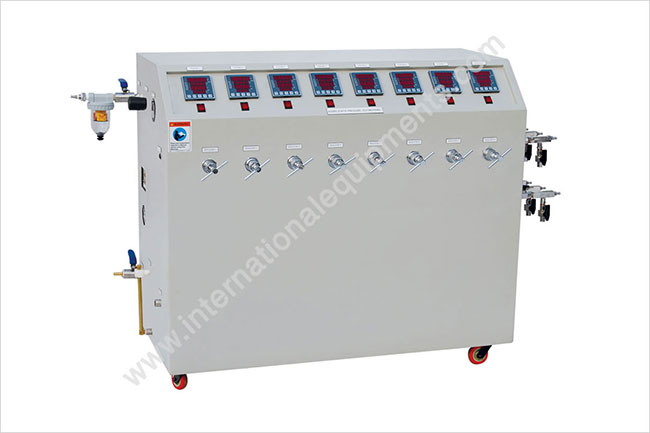
Computerised Hydrostatic Pressure Testing Equipment

Specifications Table

Parameter Specification
Pressure Range 0 to 100 bar* (other capacities available on request)
Number of Stations 8 (parallel — each independently controlled)
Pressure Input Through compressed air, pressure up to 5 kg/cm² (compressor to be supplied by customer)
Pressure Output Through hydro-pneumatic pump (water pressure at the pipe)
Time Range 0 to 999.9 hours
Panel Mounting Trolley with castor wheels
Direct Display through MMI Set Pressure, Actual Pressure, Set Time, Actual Time, Set Temperature, Actual Temperature
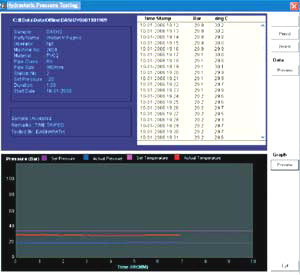
Graphic Display & Printout through PC Pressure & Temperature vs Time graph for any station via attached printer
Paint Finish Powder coated
Power Supply 230 Volts, 50 Hz, single phase

* Equipment with other capacities could also be supplied as per the requirement.
Pressure Testing Equipment

What is Hydrostatic Pressure Testing?

Hydrostatic Pressure Testing is the laboratory test in which a length of plastic pipe is sealed at both ends, filled with water, pressurised to a specified percentage of its design pressure, and held at a controlled elevated temperature for hours, days, weeks or up to 10,000 hours — depending on the specific test point being established. The pipe sample either survives the full test duration (a pass) or fails by leaking, ballooning or bursting at some point during the test (a fail). The time-to-failure data at multiple pressure-temperature combinations is then used to plot the long-term hydrostatic strength curve of the pipe material.

The technical name for this failure mechanism is creep rupture — the slow time-dependent fracture of a polymer subjected to sustained internal pressure. Different from a short-term burst test (which gives the immediate burst pressure in seconds), creep rupture testing reveals what happens over weeks, months and years of pressure loading. This is why hydrostatic pressure testing is the only laboratory method that can reliably predict the actual service life of a plastic water, gas or chemical pipe.

About Our Computerised Hydrostatic Pressure Testing Equipment

Our Computerised Hydrostatic Pressure Testing Equipment is the dedicated control panel that holds 8 pipe samples at independently controlled set pressures, set temperatures and set times — all running in parallel for maximum laboratory throughput. The pressure range is 0 to 100 bar (with other capacities available on request), which comfortably covers the test pressures specified by IS 4984 (HDPE), IS 4985 (uPVC), IS 14333 (HDPE sewerage), IS 15778 (CPVC) and the related international standards.

Compressed air supplied by the customer's compressor (up to 5 kg/cm²) is the input to a hydro-pneumatic pump inside the panel — which generates the much higher water pressure (0–100 bar) applied to the pipe samples. The hydro-pneumatic conversion is essential because plastic pipes are pressurised with water (not air, for safety reasons — a water-pressurised pipe that bursts releases far less energy than an air-pressurised one).

The time range of 0 to 999.9 hours covers all standard hydrostatic test points — from the short-term high-pressure test points (1–100 hours) right through to the long-term low-pressure points (up to ~42 days continuous testing). Trolley mounting with castor wheels lets the laboratory move the panel to the optimal position relative to the SS Tank — essential because the pipe samples sit in the heated water tank, and the panel feeds pressure to each station via flexible hoses.

Direct readout on the on-board MMI (Man-Machine Interface) shows set pressure, actual pressure, set time, actual time, set temperature and actual temperature for each station. PC connectivity adds graphical display — pressure-versus-time and temperature-versus-time graphs plotted for any station via a connected printer — giving the complete documented record needed for ISI mark certification, BIS audit and customer reporting.

Why This Is the Most Critical Pipe Test

  • The Only Test That Predicts Long-Term Service Life
    Only hydrostatic pressure testing tells you whether the pipe will survive 25 or 50 years of sustained internal pressure — by directly measuring creep rupture behaviour at multiple pressure-temperature combinations.
  • Mandatory for ISI Mark Certification
    BIS certification for ISI mark on HDPE (IS 4984), uPVC (IS 4985), HDPE sewerage (IS 14333) and CPVC (IS 15778) pipes all require in-house hydrostatic pressure testing capability.
  • 8 Parallel Stations Maximise Lab Throughput
    Hydrostatic tests run for hours or days per sample. Eight parallel stations let the lab test many samples simultaneously without becoming the production bottleneck.
  • Validates New Pipe Designs and New Polymer Grades
    Lab-scale hydrostatic testing on representative pipe samples gives creep rupture data before any commercial production commitment is made.
  • Catches Polymer Batch Variation Before Field Failure
    Periodic hydrostatic testing on production-line samples catches batch-to-batch drift in time — preventing field failures that would damage the brand and trigger warranty claims.
  • Required for Government Tender Documentation
    Most government and municipal water-supply tenders explicitly require hydrostatic pressure test reports along with dispatch documentation.

How the Creep Rupture Pressure Test Works

  • Step 1 — Prepare the Pipe Sample with End Caps
    Cut a length of pipe to the standard test specimen length. Fit pressure-tight End Caps to both ends — one with a fill port, one with a pressure inlet connected to the panel.
  • Step 2 — Place the Sample in the Heated SS Tank
    Submerge the prepared pipe sample in the temperature-controlled SS Tank, held at the specified test temperature (typically 20°C, 60°C or 80°C).
  • Step 3 — Connect to the Panel and Pressurise
    Connect the sample to one of the 8 stations via a flexible high-pressure hose. Enter the set pressure, time and temperature on the MMI; the hydro-pneumatic pump pressurises the pipe water to the set pressure.
  • Step 4 — Hold for the Specified Test Duration
    The panel holds the set pressure for the set time — anywhere from 1 hour up to 999.9 hours (~42 days). The MMI displays actual readings; the PC continuously logs and plots the data.
  • Step 5 — Record the Result and Plot the Curve
    A surviving sample passes that test point; a failed sample records time-to-failure. Multiple test points are used to plot the long-term hydrostatic strength (LTHS) curve.

SS Tank & End Caps — Required Companion Equipment

The Hydrostatic Pressure Testing Panel is the central control unit — but it cannot operate in isolation. To run the actual test, the laboratory needs three components:

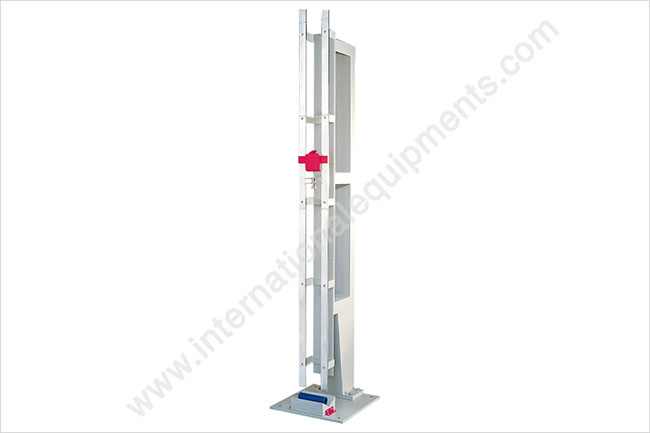
  • Hydrostatic Pressure Testing Panel (This Product)
    The 8-station control panel described on this page — generates and controls the water pressure delivered to each pipe sample, with MMI direct readout and PC graph logging. This is the brain and pressure generator of the system.
  • SS Tank for Hydrostatic Pressure Testing
    The stainless steel water tank in which the pipe samples are submerged at the controlled test temperature. Available in capacities from 500 litres up to 4000 litres — sized to suit the customer's typical pipe length and quantity tested in parallel. Sold separately, often as a matched-package purchase with the Hydrostatic Panel. See SS Tank for Hydrostatic Pressure Testing.
  • End Caps
    The pressure-tight caps that seal each end of the pipe sample. One cap has a fill port for water; the other has the pressure-inlet fitting for connection to the panel. End cap sizes range from 16 mm to 450 mm to suit the full pipe diameter range.
  • Compressor (Customer-Supplied)
    The Hydrostatic Panel runs on compressed air at up to 5 kg/cm² — supplied by the customer's existing plant compressor or a separately-purchased lab compressor. Not included with the panel standard supply.

Technical Information

  • IS 4984 — Indian Standard for HDPE pipes for potable water supply (hydrostatic pressure clause is the central pass-fail test)
  • IS 4985 — Indian Standard for unplasticized PVC (uPVC) pipes for potable water supply
  • IS 14333 — Indian Standard for HDPE pipes for sewerage system
  • IS 14930 — Indian Standard for HDPE corrugated pipes (telecom PLB duct)
  • IS 15778 — Indian Standard for CPVC pipes for hot and cold water supply
  • IS 15801 — Indian Standard for PPR pipes for hot and cold water supply
  • ISO 1167 — Plastics piping systems — Determination of the resistance to internal pressure (the international parent standard)
  • ISO 4427 — Plastics piping systems — Polyethylene (PE) pipes for water supply
  • ISO 4437 — Polyethylene (PE) pipes for the supply of gaseous fuels
  • ASTM D 1598 — Standard Test Method for Time-to-Failure of Plastic Pipe Under Constant Internal Pressure
  • ASTM D 1599 — Standard Test Method for Resistance to Short-Time Hydraulic Pressure of Plastic Pipe
  • ASTM D 2837 — Standard Test Method for Obtaining Hydrostatic Design Basis for Thermoplastic Pipe
  • Hydrostatic pressure testing of HDPE water-supply pipes per IS 4984
  • Hydrostatic testing of uPVC pipes per IS 4985
  • Hydrostatic testing of HDPE sewerage pipes per IS 14333
  • Long-term creep rupture testing of CPVC hot-water pipes per IS 15778
  • Long-term creep rupture testing of PPR pipes per IS 15801
  • Time-to-failure testing per ASTM D 1598 / ISO 1167
  • Long-term hydrostatic strength (LTHS) determination per ASTM D 2837
  • ISI mark certification routine QC testing
  • Government tender dispatch documentation
  • BIS audit demonstration of in-house hydrostatic testing capability
  • Validation of new pipe designs and new polymer grades (R&D)
  • Verification of recycled-polymer pipe performance
  • Quality verification of incoming raw-material polymer batches
  • Pressure-rating qualification for export to Middle East, Africa, Europe and South-East Asia
  • HDPE Pipe Manufacturers (water supply, sewerage, irrigation, gas)
  • uPVC & PVC Pipe Manufacturers (water supply, drainage)
  • CPVC Pipe Manufacturers (hot & cold water plumbing)
  • PPR Pipe Manufacturers (hot & cold water plumbing, HVAC)
  • LDPE & Drip-Irrigation Pipe Manufacturers
  • PE Gas-Pipe Producers
  • Polymer & Master-batch Compounders
  • Recycled-Plastic Pipe Processors
  • Government Testing Labs, NABL Accredited Labs & BIS-Approved Test Houses
  • Municipal & Government Water-Supply Departments (third-party verification)
  • Petrochemical & Resin Producers
  • R&D Centres of Plastic Pipe Manufacturers
  • 8 Parallel Stations — Maximum Lab Throughput
    Eight independently-controlled test stations let the QC lab run multiple pressure-temperature-time combinations in parallel — essential when test cycles are hours, days or weeks long.
  • Full 0 to 100 Bar Range (Other Capacities Available)
    Standard 0–100 bar range comfortably covers the test pressures specified by IS 4984, IS 4985, IS 15778 and the related Indian, ISO and ASTM standards.
  • 999.9 Hour Time Range — Long-Duration Creep Rupture Testing
    Time range up to ~42 days continuous testing handles the long-duration test points required for LTHS curve determination per ASTM D 2837 and ISO 9080.
  • MMI Direct Readout + PC Graph Plotting
    On-board Man-Machine Interface for direct station-by-station monitoring plus PC software for graphical pressure-vs-time and temperature-vs-time plotting.
  • Trolley Mounting for Easy Lab Positioning
    Castor-wheeled trolley lets the panel be repositioned near the SS Tank or moved out of the way when not in use.
  • Complete System Supplied with SS Tank and End Caps
    We supply the matched Hydrostatic Panel + SS Tank (500–5000 litres) + End Caps (16–450 mm diameter range) as a complete package — one quotation, one commissioning visit, one set of calibration certificates.
  • Used by Leading Indian Pipe Manufacturers
    Our Hydrostatic Pressure Testing Equipment is installed in many of India's largest HDPE, PVC, CPVC and PPR pipe manufacturing plants — client list available on request.
  • ISO & CE Certified Manufacturing
    Designed and built at our Mumbai facility under ISO certified quality systems, with CE marking for export to the Middle East, Africa, South-East Asia, Europe and South America.
  • Free Installation, Training & Calibration
    Free on-site installation of the complete system, operator training on the hydrostatic test method including LTHS curve generation, and factory calibration certificates anywhere in India. AMC available for long-term support.

FAQs

Creep is the slow time-dependent deformation of a polymer under sustained load. Rupture is the eventual breaking of the material. Together, creep rupture is the failure mode that limits the long-term life of any plastic pipe under sustained internal pressure — the polymer slowly creeps under load, eventually developing a crack that propagates to failure. Hydrostatic pressure testing directly measures this creep rupture behaviour by holding the pipe at constant pressure and temperature and recording how long it takes to fail. This is fundamentally different from a short-term burst test, which records only the immediate burst pressure in seconds and tells you nothing about long-term service life.
The panel uses a hydro-pneumatic pump for safety reasons. Plastic pipes must be pressurised with water (not air) because a water-filled pipe that bursts releases far less energy than an air-filled pipe (water is nearly incompressible). The hydro-pneumatic pump uses customer-supplied compressed air (at up to 5 kg/cm²) as its driver to generate the much higher water pressure (0–100 bar) applied to the pipe sample. This is the standard safe configuration used by hydrostatic test equipment worldwide. Customer must supply a separate plant compressor or laboratory compressor; it is not included with the panel.
Hydrostatic tests run for hours, days, or even up to ~42 days per sample. With only one or two test stations, a single long-duration test would block all other testing on that panel, making it impossible to keep up with the QC requirements of a production line. Eight stations let the lab run multiple tests in parallel — different pressures, different temperatures, different polymer batches — giving the throughput needed for routine BIS-certified QC plus R&D testing on the same equipment.
The Hydrostatic Panel is the control unit — it generates and controls the water pressure, runs the MMI display, logs data to PC. The SS Tank is the heated water bath — it holds the pipe samples submerged in temperature-controlled water during the test. The two are sold separately because customers' SS Tank size needs (500 L to 4000 L) vary by their pipe length and quantity. Both are required to actually run a hydrostatic test. We commonly supply the matched pair plus end caps as a complete-package quotation.
The panel itself handles any diameter from 16 mm to 400 mm (per the live-page specification) when used with appropriately sized end caps. We supply end caps in the 16 mm to 450 mm range to match. The SS Tank size determines how long a pipe sample can be tested — larger tanks hold longer samples, important for the diameter-to-length ratio specified by ISO 1167. Please share your typical pipe diameter range and standard sample length in your enquiry so we can recommend the right end cap set and SS Tank size.
It depends on the test purpose. Routine ISI mark QC tests typically use a relatively short duration (e.g., 100 hours, 1000 hours) at conditions chosen to give a pass/fail in a manageable time. Long-Term Hydrostatic Strength (LTHS) curve generation per ASTM D 2837 or ISO 9080 typically uses test points up to 10,000 hours (over 13 months) extrapolated to estimate 50-year service life. Our panel's 999.9 hour timer covers ~42 days of continuous testing per cycle — long enough for most certification testing; longer-duration tests run as sequential cycles on the same sample.
ISI mark certification by BIS requires the pipe manufacturer to demonstrate in-house capability for all the tests specified in the relevant Indian Standard. For HDPE water pipes (IS 4984) and PVC water pipes (IS 4985), the hydrostatic pressure test is among the most important pass-fail tests. BIS auditors expect to see (a) the Hydrostatic Panel installed and operational in the QC lab, (b) operator competence in running the test, (c) maintained test records demonstrating periodic batch-by-batch testing, and (d) the equipment's calibration certificate. Our Hydrostatic Panel + SS Tank + End Caps package is designed to satisfy all four requirements.
Yes. We provide free on-line installation of the Hydrostatic Panel and SS Tank (on-site is chargeable), operator training on the complete hydrostatic test method (including LTHS curve generation methodology per ASTM D 2837 / ISO 9080), and factory calibration certificates for the pressure sensors, temperature sensors and time counter at the customer's location anywhere in India. The training is particularly important for this equipment because the test methodology has multiple time-pressure-temperature combinations that operators must understand. Yearly calibration visits are offered at additional cost after completion of 1 year.

Setting up or expanding your pipe QC laboratory?

Contact International Equipments today for a personalised quotation on the complete Hydrostatic Pressure Testing system — Panel + SS Tank + End Caps. Tell us your pipe diameter range, standard test sample length, target test standards (IS 4984, IS 4985, IS 15778, ISO 1167) and SS Tank capacity needed (500 L to 4000 L) — our team will share package pricing, delivery timeline and the list of leading BIS-certified pipe manufacturers already using our Hydrostatic Pressure Testing Equipment.

Get Free Quote