Request
Quote

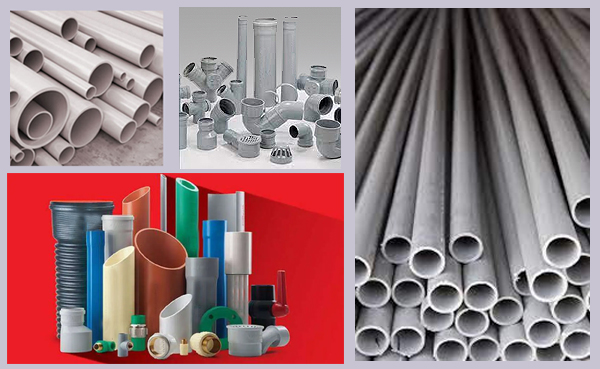
International Equipments is a leading manufacturer, supplier and exporter of complete laboratory testing equipment for the plastic pipe manufacturing industry in India. Built at our Mumbai facility and exported to over 60 countries, our testing instruments are installed in the QC laboratories of many of India's largest HDPE, PVC, CPVC, PPR, LDPE and corrugated pipe manufacturers — used at every stage of production from incoming polymer granule QC right through to finished-pipe hydrostatic pressure validation.
Plastic pipes carry water, gas, fuel, sewage, irrigation flow, telecom cables and chemical fluids — for service lives of 25, 50, even 100 years. Every metre of pipe must meet a long list of national and international acceptance tests before it can be released for sale: tensile properties, ring stiffness, hydrostatic pressure resistance, melt flow rate, Vicat softening point, heat deflection temperature, carbon black content, carbon black dispersion, impact resistance and oxidation induction time. This page presents the complete recommended testing setup with direct links to each individual instrument page.
Plastic pipe is one of the most heavily regulated polymer product categories in India and worldwide. Bureau of Indian Standards (BIS) certification, ISI mark licences, NSF certification for potable-water pipes, and customer audits all require the manufacturer to demonstrate ongoing in-house testing capability across a wide range of tests. Outsourcing this to external labs slows down production releases (test results that take days instead of hours) and adds significant per-batch cost.
A complete in-house QC laboratory is therefore not a luxury but a competitive necessity for any plastic pipe manufacturer. The 11 instruments described on this page are the standard equipment set found in every well-equipped pipe-manufacturer's lab — together they cover the IS 4984 (HDPE), IS 4985 (uPVC), IS 14333 (PE pipes for potable water), IS 15778 (CPVC), ASTM D 3350 (HDPE), ASTM D 1785 (PVC) and the relevant BS/ISO pipe standards.
International Equipments supplies the entire instrument set under one roof, with one quotation, one commissioning visit, one set of calibration certificates. This makes us the preferred partner for new pipe-plant setups, capacity expansions and lab upgrades across India and the export market.
Plastic pipes have varied applications in all types of industries from irrigation to Telecom. Depending on varied applications different category of pipes such as HDPE, PVC, C-PVC, PPR, LDPE, Corrugated pipes are produced & offered in industrial as well as domestic localities in accordance to IS 4984 & IS 4985, and several BS/ISO standards. HDPE pipes are characterized by higher specific strength and heat resistance. LDPE pipes have lower strength and temperature resistance. Corrugated pipes are mainly used in Telecom sector for cable protection with features such as flame resistance and many more durability characteristics.
HDPE (High-Density Polyethylene) Pipes
Used for potable water supply, sewerage, irrigation, gas distribution and industrial fluid transport. Characterised by higher specific strength, heat resistance and long-term hydrostatic strength. Tested per IS 4984, IS 14333. ESCR, OIT, MFI and hydrostatic pressure tests are critical for HDPE pipes.
PVC (Polyvinyl Chloride) Pipes
Rigid PVC pipes (uPVC) used for cold water supply, drainage and conduit. Tested per IS 4985, ASTM D 1785. Impact resistance, Vicat softening point and hydrostatic pressure are the most important tests for PVC pipes.
CPVC (Chlorinated PVC) Pipes
Higher-temperature variant of PVC used for hot and cold potable water plumbing. Tested per IS 15778 and ASTM D 2846. Vicat softening point, heat deflection temperature, hydrostatic pressure and impact tests are essential for CPVC.
PPR (Polypropylene Random Copolymer) Pipes
Used for hot and cold potable water systems and HVAC. Tested per IS 15801 and DIN 8077. MFI, VSP/HDT and hydrostatic pressure are key acceptance tests.
LDPE (Low-Density Polyethylene) Pipes
Flexible, lower-pressure pipes used for drip irrigation, water supply and chemical transfer. Lower strength and temperature resistance than HDPE. MFI, density and tensile tests are standard.
Corrugated Pipes (HDPE PLB Duct, Telecom Cable Duct)
Used in the telecom sector for cable protection — feature flame resistance and high impact strength. Tested per IS 14930 and DOT specifications. Impact tests (with cold conditioning), ring stiffness and OIT are the critical tests for telecom-duct corrugated pipes.
At International Equipment, we offer equipments to test few of such tests of plastic pipes and few such equipment are listed below:
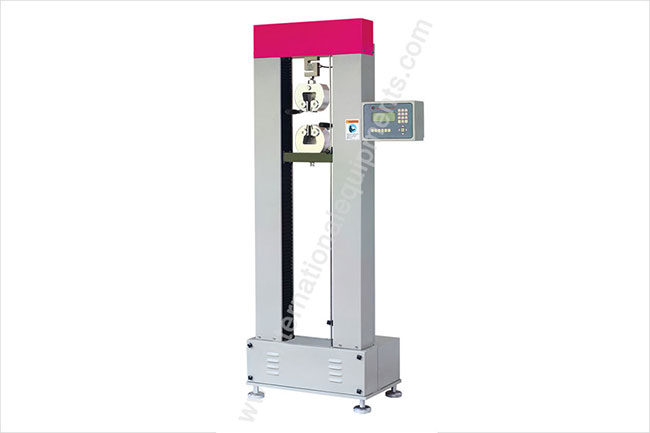
To check properties of Tensile, Elongation, Compression, Ring Stiffness and Flexural (Three point bending) typically the range is from 1000 kg (10 KN) to 5000 kg (50 KN).
The UTM is the single most important instrument in a plastic pipe QC laboratory — it performs Tensile, Compression, Ring Stiffness and Three-Point Bending Flexural tests on the same frame, with capacities tailored to the pipe diameter range. For large-diameter pipes, the 50 kN capacity easily handles the standard ring-stiffness fixture per ISO 9969. For smaller diameter pipes and pipe-strip tensile testing, the same machine with lower-load grips delivers ASTM D 638 / ISO 527 compliant tensile data.
What it tests: Tensile strength, elongation, compression strength, ring stiffness, flexural strength of pipe strips and pipe rings
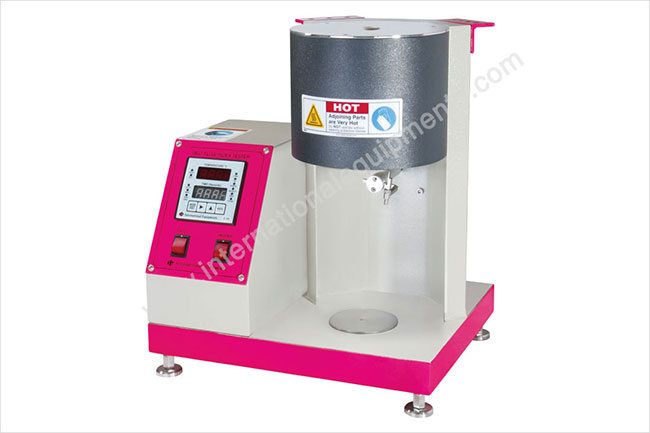
Digital Melt flow Index tester to check flow properties of plastics.
Every batch of HDPE, LDPE, PP, PVC and CPVC compound coming into the pipe extrusion line must be MFI-checked before processing. Off-spec MFI shows up immediately as extrusion problems — surface defects, wall thickness variation, brittleness. The MFI Tester is the gatekeeper between incoming raw material and the production line. Available in manual, auto-cut and fully computerized models.
What it tests: Melt Flow Rate (MFR in g/10 min) of HDPE, LDPE, PP, PVC and CPVC compounds used for pipe extrusion
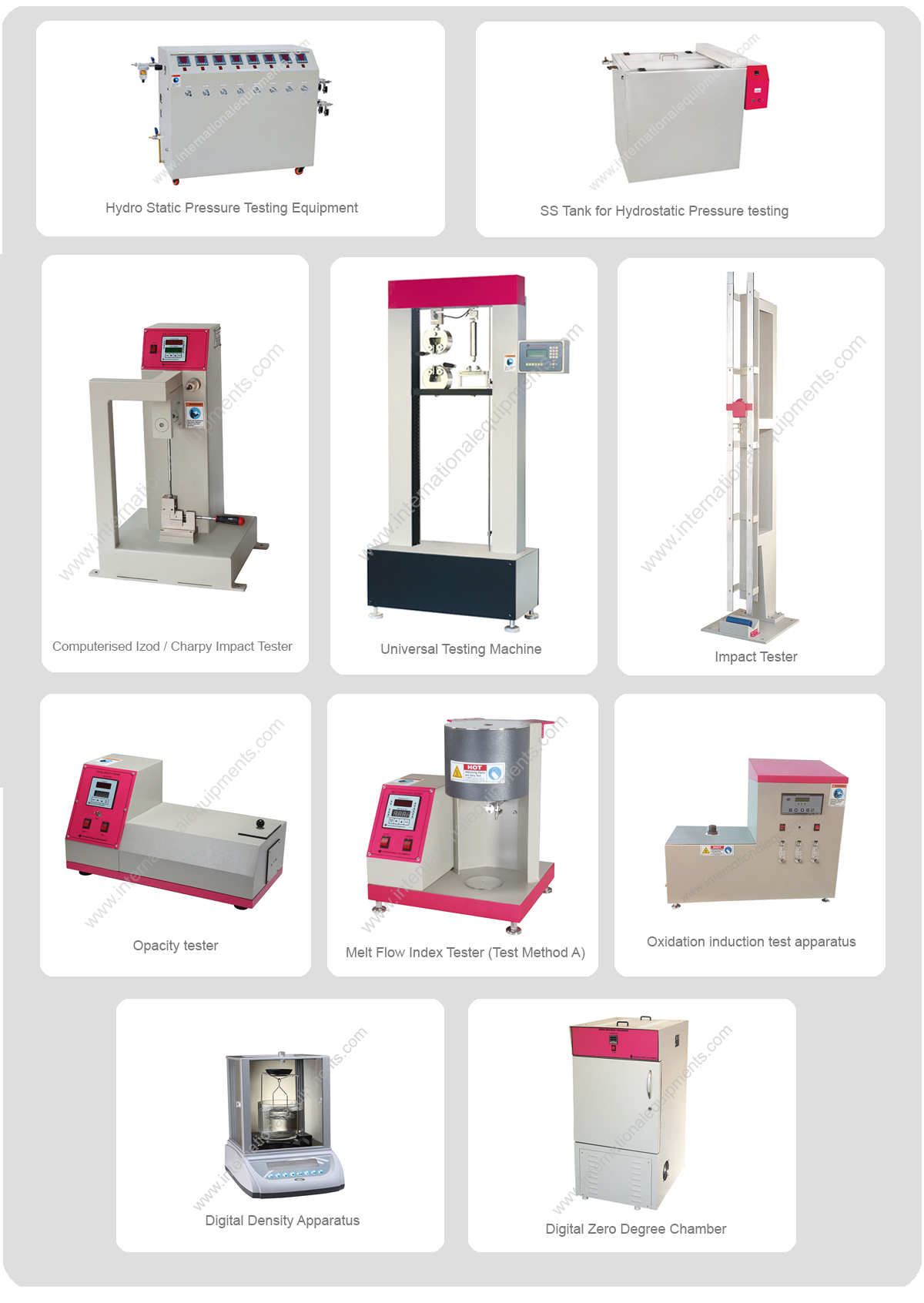
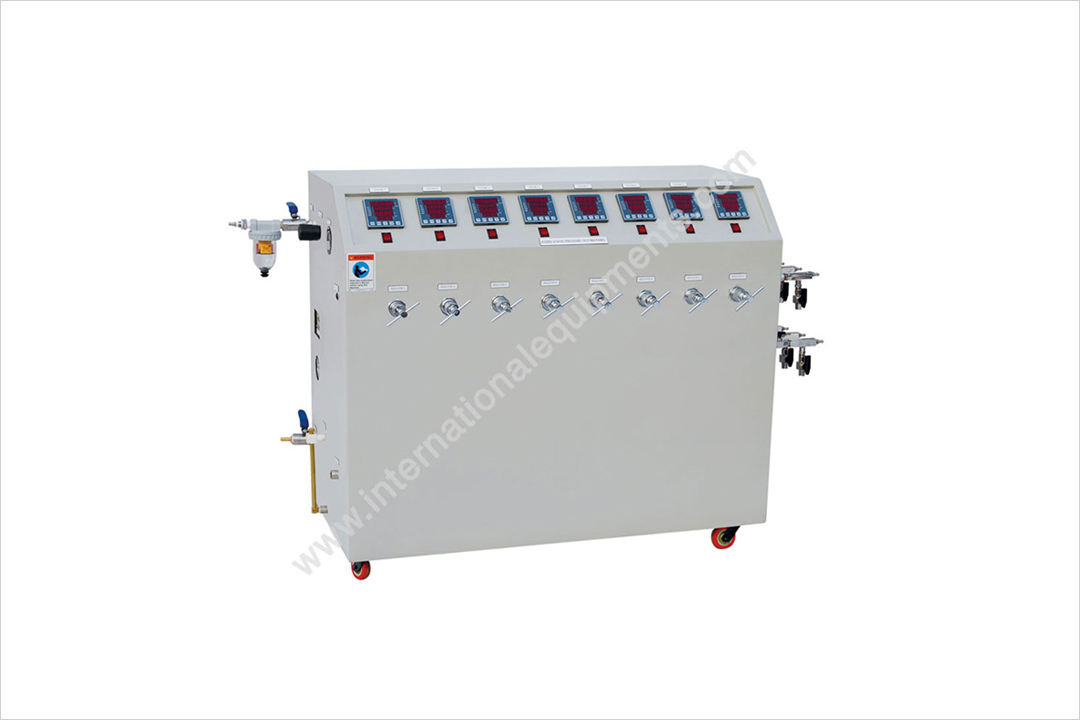
Computerized Hydrostatic Pressure Testing comprising of Hydrostatic Pressure test Panel, SS tank of sizes ranging from 500 litres to 4000 litres, end caps ranging from 16 mm to 450 mm. Mainly applicable to thermoplastic pipes which are functional in movement of fluids.
The Hydrostatic Pressure Testing system is the most critical long-term-life test for any pressure-rated plastic pipe — HDPE water pipes, PVC plumbing pipes, CPVC hot-water pipes and PPR pipes. The pipe is filled with water, pressurised to a specified percentage of its design pressure, and held at a controlled temperature for hours, days or up to 10,000 hours, depending on the test. Pipes that pass survive their design service life; pipes that fail leak or burst during the test, well before they ever reach the customer. The complete system includes a Hydrostatic Pressure Test Panel (the control unit), an SS Tank (500–4000 L), and end caps to suit pipe sizes from 16 mm to 450 mm diameter.
What it tests: Long-term hydrostatic pressure resistance of HDPE, PVC, CPVC, PPR water and gas pipes per ISO 1167 / ASTM D 1598
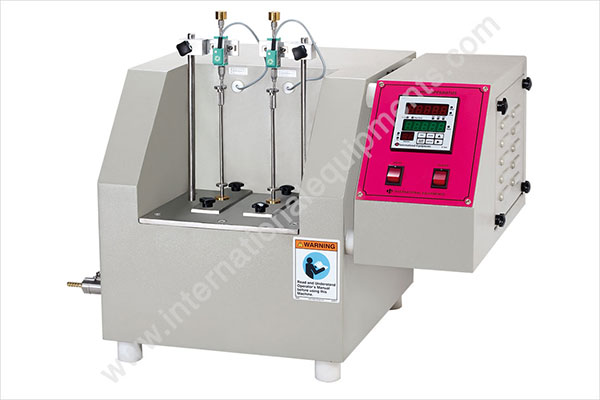
Computerized VSP/HDT apparatus to check softening point and heat deflection.
Vicat Softening Point (VSP) and Heat Deflection Temperature (HDT) are critical thermal-performance tests for CPVC, PVC, PPR and any pipe that will carry hot fluids or be exposed to elevated ambient temperatures. The VSP test (ASTM D 1525, ISO 306) measures the temperature at which a standard indenter penetrates the polymer surface — directly indicating the maximum service temperature. HDT (ASTM D 648, ISO 75) measures the temperature at which the material deflects under a defined load. Both are mandatory acceptance tests in CPVC and PPR pipe specifications.
What it tests: Vicat Softening Point and Heat Deflection Temperature of CPVC, PVC, PPR and engineering thermoplastic pipes
Carbon Content apparatus to check carbon percentage.
HDPE pipes designed for outdoor service (water supply, irrigation, gas distribution, telecom PLB ducts) must contain a specified percentage of carbon black to protect against UV degradation. IS 4984, IS 14333, ASTM D 3350 and the DOT specification for PLB duct all specify a minimum carbon black content (typically 2.0 to 2.5%) with tight tolerances. Too little carbon black means the pipe will become brittle in UV exposure within months; too much wastes raw material. The Carbon Black Content Apparatus uses pyrolysis in nitrogen atmosphere to give the exact carbon percentage.
What it tests: Carbon black percentage (UV stabiliser content) of HDPE pipe compounds and finished pipe samples
Carbon dispersion to check dispersion of carbon in polymer used to produce pipes.
Carbon black content tells you how much carbon black is in the polymer; carbon black dispersion tells you how well it is distributed. Even with the correct percentage, poorly dispersed carbon black (visible agglomerates under the microscope) creates stress concentrations in the pipe wall — points where premature failure starts. IS 4984 and ISO 18553 specify maximum allowable agglomerate sizes in the polymer. The Carbon Black Dispersion Tester is a calibrated microscope-based instrument that grades the dispersion against standard reference charts.
What it tests: Carbon black dispersion quality (agglomerate size and frequency) in HDPE pipe compounds per ISO 18553
Impact tester and deep freezer for checking impact on pipes.
Plastic pipes — especially PVC water-supply pipes and corrugated PLB ducts — must withstand impact at low temperature (typically 0°C or below) without cracking. The Impact Tester drops a calibrated weight onto a pipe specimen and detects whether the pipe cracks. The Deep Freezer (Zero Degree Chamber) pre-conditions the pipe sample to the specified low temperature before the impact test. IS 4985, IS 14930 and the PLB duct DOT specification all require this combined low-temperature impact test.
What it tests: Impact resistance of PVC, HDPE and corrugated pipes at low temperature (0°C and below) per IS 4985 / IS 14930
Izod / Charpy impact tester for checking pendulum impact on pipes.
Pendulum-type Izod and Charpy impact tests are used to measure the toughness of pipe material on notched specimens cut from the pipe wall — complementing the drop-weight impact tests on whole-pipe samples. The Izod / Charpy Impact Tester is the standard instrument specified by ASTM D 256 and ISO 180 for these notched-bar pendulum impact measurements. Required by many CPVC and engineering-grade pipe specifications.
What it tests: Notched-bar pendulum impact strength of pipe material specimens per ASTM D 256 / ISO 180
Opacity tester to check opaqueness.
HDPE water and gas pipes must be completely opaque so that algae and bacterial growth cannot occur from sunlight penetrating the pipe wall in service. The Opacity Tester measures the percentage of light transmitted through a pipe wall sample — pipe specifications require essentially 0% light transmission. A failed opacity test means the pipe will support algae growth and is unfit for potable-water service. This test is mandatory per IS 4984 and IS 14333 for water-supply pipes.
What it tests: Light transmission (opacity) of HDPE and PE pipe wall samples per IS 4984 / IS 14333
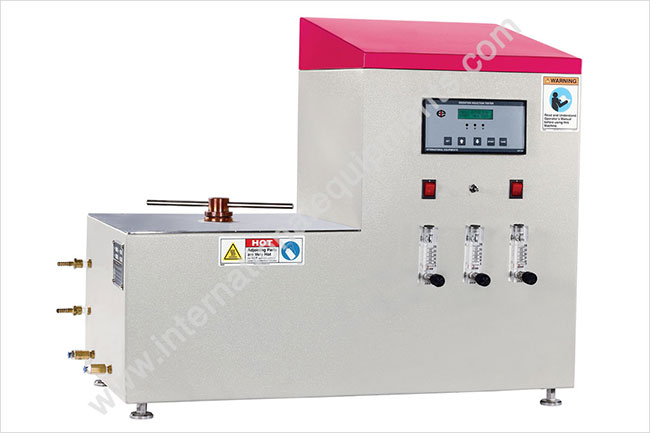
Oxidation induction test apparatus for checking anti-oxidant properties in HDPE/MDPE pipe.
OIT measures the remaining antioxidant life in HDPE and MDPE pipe material — the most important long-term life-prediction test for any polyethylene pipe. A high OIT value (typically 20+ minutes at 200°C in oxygen) means the pipe will resist oxidative ageing for its 50-year service life; a low OIT value means the antioxidants have already been depleted and the pipe will become brittle and crack prematurely. IS 4984, IS 14333, ISO 4427 and the DOT PLB-duct specification all require OIT as a mandatory acceptance test. Our DTA-based apparatus is supplied complete with 500 aluminium pans, Indium calibration material and PC software.
What it tests: Oxidation Induction Time (OIT) of HDPE, MDPE pipe material per ASTM D 3895 / ISO 11357-6 / DOT specifications
Contour Cutter and templates along with Hydraulic Press and Die to prepare specimen for testing.
Reliable test results depend on correctly prepared specimens. Tensile, flexural, impact and ESCR tests all require specimens cut to exact ASTM/ISO dimensions from the pipe wall. The Contour Cutter, with appropriate templates, cuts pipe-wall samples into the standard dumbbell, strip and bar specimens required by the relevant test standard. The Hydraulic Press with cutting dies is the higher-volume alternative — pressing specimens out of flat sheet material cut from the pipe wall.
What it tests: Sample preparation — cutting standard ASTM / ISO dimension test specimens from pipe walls for tensile, flexural, impact and ESCR testing
IS 4984 — Indian Standard for HDPE pipes for potable water supply
IS 4985 — Indian Standard for unplasticized PVC (uPVC) pipes for potable water supply
IS 14333 — Indian Standard for HDPE pipes for sewerage system
IS 14930 — Indian Standard for HDPE corrugated pipes (telecom PLB duct)
IS 15778 — Indian Standard for CPVC pipes for hot and cold water supply
IS 15801 — Indian Standard for PPR pipes for hot and cold water supply
ASTM D 3350 — Standard Specification for Polyethylene Plastics Pipe and Fittings Materials
ASTM D 1785 — Standard Specification for PVC Plastic Pipe (Schedules 40, 80, 120)
ASTM D 2846 — Standard Specification for CPVC Plastic Hot- and Cold-Water Distribution Systems
ISO 4427 — Plastics piping systems — Polyethylene (PE) pipes for water supply
ISO 4437 — Polyethylene (PE) pipes for the supply of gaseous fuels
ISO 1452 — Plastics piping systems for water supply — Unplasticized poly(vinyl chloride) (PVC-U)
ISO 1167 — Plastics piping systems — Resistance to internal pressure
ISO 9969 — Thermoplastics pipes — Determination of ring stiffness
ISO 18553 — Method for the assessment of the degree of pigment or carbon black dispersion in polyolefin pipes
DOT (Department of Telecom) Specifications — for HDPE PLB duct testing
BS 3505 — British Standard for unplasticized PVC pipes for cold water
DIN 8077 — German Standard for PPR pipes
Different types of plastic pipe require different combinations of tests. The matrix below shows which tests are typically applied to each type:
HDPE Water & Sewerage Pipes
UTM (tensile, ring stiffness), MFI Tester, Hydrostatic Pressure, Carbon Black Content, Carbon Black Dispersion, Opacity, OIT
PVC / uPVC Water Pipes
UTM (tensile, ring stiffness), MFI, Hydrostatic Pressure, VSP, Impact Tester + Deep Freezer (low-temp impact), Izod/Charpy Impact
CPVC Hot-Water Pipes
UTM, VSP, HDT, Hydrostatic Pressure (elevated temperature), Izod/Charpy Impact
PPR Pipes
UTM, MFI, VSP, HDT, Hydrostatic Pressure (long-term, elevated temperature)
LDPE Drip Irrigation Pipes
UTM (tensile, elongation), MFI Tester, Density Apparatus
Corrugated HDPE PLB Duct (Telecom)
UTM (ring stiffness), MFI, Impact Tester + Deep Freezer, OIT, Carbon Black Content, Opacity — all per DOT specification
Gas Distribution PE Pipes
UTM, MFI, Hydrostatic Pressure, Carbon Black Content & Dispersion, OIT, ESCR
Complete Pipe-Lab Package, One Supplier
Buy your entire plastic pipe QC laboratory from a single manufacturer — UTM, Hydrostatic Pressure System, MFI Tester, OIT, VSP/HDT, Carbon Black Content & Dispersion, Impact Tester + Deep Freezer, Izod/Charpy, Opacity Tester and Contour Cutter — ensuring instrument compatibility and one point of contact for service.
Used by Leading Indian Pipe Manufacturers
Our equipment is installed in many of India's largest HDPE, PVC, CPVC, PPR and PLB duct manufacturing plants — client list available on request, including BIS-certified ISI mark holders and DOT-approved PLB duct suppliers.
Full Coverage of IS, ASTM, ISO & DOT Standards
Every instrument complies with the relevant Indian Standards (IS 4984, IS 4985, IS 14333, IS 14930, IS 15778, IS 15801), ASTM standards (D 3350, D 1785, D 2846), ISO standards (4427, 4437, 1167, 9969, 18553) and DOT specifications for PLB duct.
Custom Hydrostatic Configurations
Hydrostatic Pressure Testing supplied with SS tanks from 500 to 4000 litres and end caps from 16 mm to 450 mm pipe diameter — matched to YOUR product range, not a one-size-fits-all unit.
ISO & CE Certified Manufacturing
Designed and built at our Mumbai facility under ISO certified quality systems, with CE marking for export to the Middle East, Africa, South-East Asia, Europe and South America.
Calibration Support
We offer one calibration visit per year, which is sufficient to maintain the accuracy and performance of the equipment. The calibration visit is provided after completion of the initial 1-year warranty period.
For ISI mark certification under IS 4984 / IS 14333 (the two main BIS standards for HDPE water pipes), the manufacturer must demonstrate in-house capability for: Tensile strength, MFI, Hydrostatic Pressure (sustained pressure test), Carbon Black Content, Carbon Black Dispersion, Opacity (light transmission), OIT (Oxidation Induction Time), and Density. Our complete plastic pipe testing package covers every one of these mandatory tests with BIS-acceptable equipment. Please discuss your specific certification scope with us during the quotation stage.
Two tests together predict long-term pipe life: Hydrostatic Pressure Testing (the direct measurement of how long the pipe survives at design pressure and temperature) and OIT — Oxidation Induction Time (which measures remaining antioxidant life and is the most reliable laboratory predictor of 25-50 year service life). Pipes that pass both at the time of manufacture will achieve their rated service life. Pipes that fail either test will fail prematurely in service.
Yes, they test different things. The drop-weight Impact Tester (used with the Deep Freezer for cold conditioning) tests whole pipe sections — the failure mode you actually see in service when a pipe is dropped, struck or impacted in installation. The Izod / Charpy Impact Tester tests notched specimens cut from the pipe wall — giving a material-property toughness value that can be compared between batches and against standards. Both are commonly required in pipe specifications, and most well-equipped pipe QC labs have both.
Our standard Hydrostatic Pressure system handles pipes from 16 mm to 450 mm diameter using interchangeable end caps. The SS Tank is offered in capacities from 500 litres (suitable for shorter pipe samples or smaller diameters) to 4000 litres (for full-length large-diameter pipe testing). We match the system configuration to your actual product range — please share your pipe diameter range and standard test-sample length in your enquiry.
Yes. Our Twin Column Universal Testing Machine in the 10–50 kN capacity range performs Tensile, Compression, Three-Point Bending Flexural AND Ring Stiffness on the same frame — you simply change the fixture. Ring Stiffness per ISO 9969 uses a parallel-plate compression fixture on a ring sample cut from the pipe. Tensile testing uses standard pneumatic or wave grips on pipe-wall strip specimens. The PC software identifies the test type and applies the correct calculation.
HDPE PLB Duct for telecom and power cable protection is governed by a separate Department of Telecom (DOT) specification with strict requirements for OIT (Oxidation Induction Time), Carbon Black Content (typically 2.0–2.5%), low-temperature impact resistance, and ring stiffness. The DOT specification is unique to India and is required for any PLB duct supplied to BSNL, BharatNet, Reliance Jio, Airtel and most government telecom infrastructure projects. We have a dedicated 'Testing Equipment for HDPE PLB Duct Manufacturers' page that covers this specification in detail.
Yes. A complete plastic pipe testing laboratory typically includes all 11 instruments listed on this page. We supply the complete laboratory as a single quotation with a single commissioning visit, a single training programme covering all instruments, and a single set of calibration certificates. Package pricing is generally more attractive than the sum of individual instrument prices. Please ask in your enquiry for a complete-laboratory quotation.
Yes. For customers buying a complete plastic pipe QC laboratory from us, we provide free on-line installation of every instrument, operator training on each test method and each instrument's software, and factory calibration certificates anywhere in India. A single commissioning team installs and commissions all the instruments together, minimising plant disruption.
Universal Testing Machine (UTM)
Hydrostatic Pressure Panel

SS Tank for Hydrostatic Pressure
Melt Flow Index Tester
VSP / HDT Apparatus
Oxidation Induction Tester (OIT)
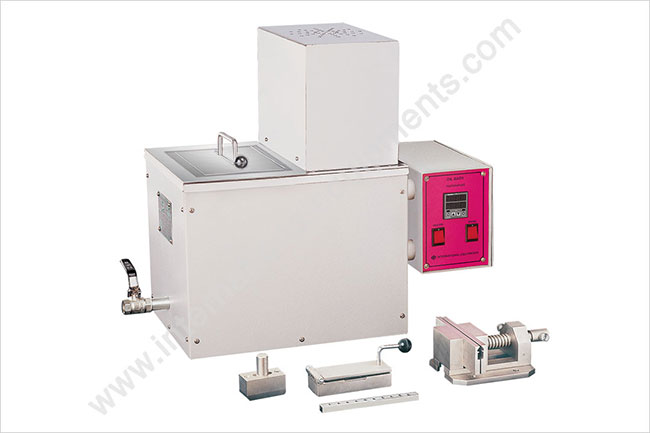
E.S.C.R. Apparatus
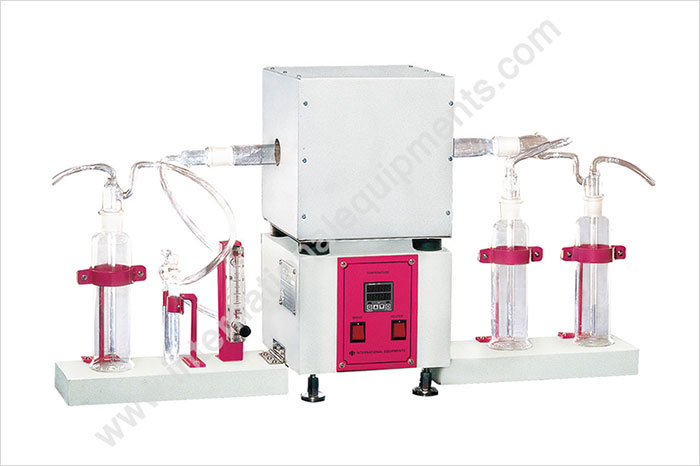
Carbon Black Content Apparatus
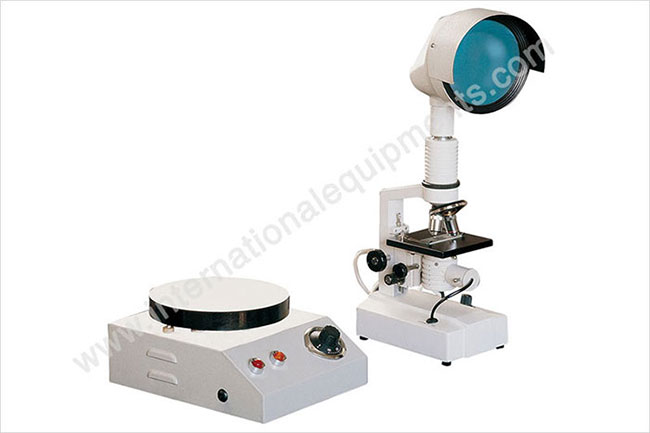
Carbon Black Dispersion Tester
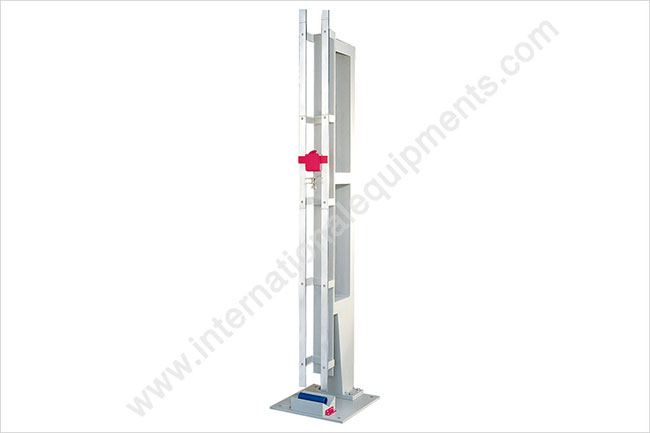
Impact Tester
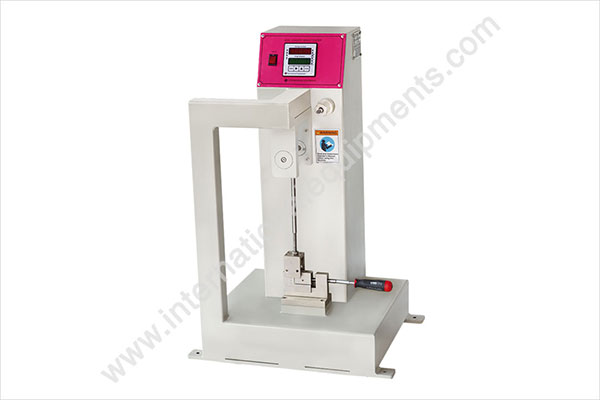
Izod / Charpy Impact Tester
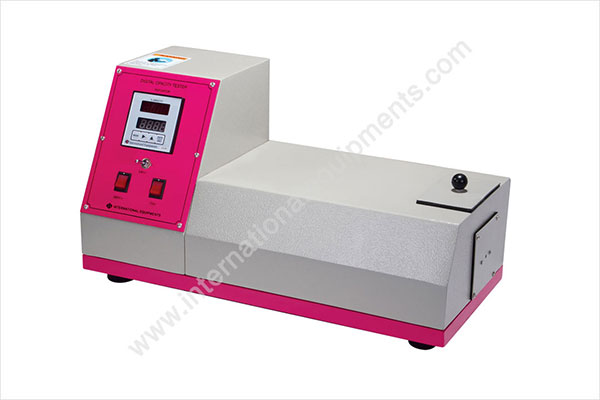
Opacity Tester
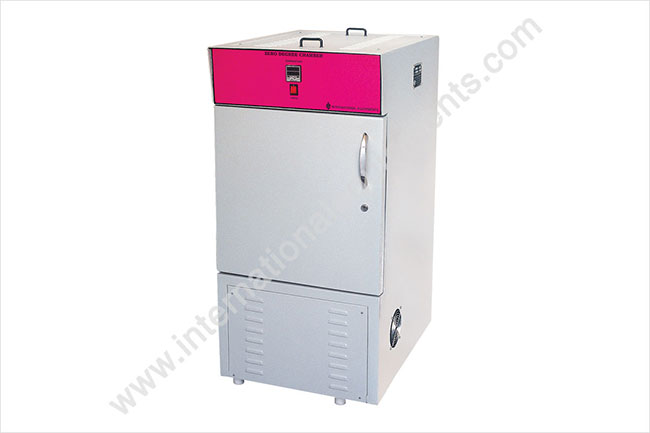
Zero Degree Chamber (Deep Freezer)
Testing Equipment for HDPE PLB Duct Manufacturers

Testing Equipment for Recycled Plastics
Universal Testing Machine (UTM)
Hydrostatic Pressure Panel
SS Tank for Hydrostatic Pressure
Melt Flow Index Tester
VSP / HDT Apparatus
Oxidation Induction Tester (OIT)
E.S.C.R. Apparatus
Carbon Black Content Apparatus
Carbon Black Dispersion Tester
Impact Tester
Izod / Charpy Impact Tester
Opacity Tester
Zero Degree Chamber (Deep Freezer)
Testing Equipment for HDPE PLB Duct Manufacturers
Testing Equipment for Recycled Plastics
Contact International Equipments today for a personalised quotation, demo video, or factory visit. Our team is ready to help you choose the right MFI tester model for your laboratory.
Get Free Quote