Request
Quote

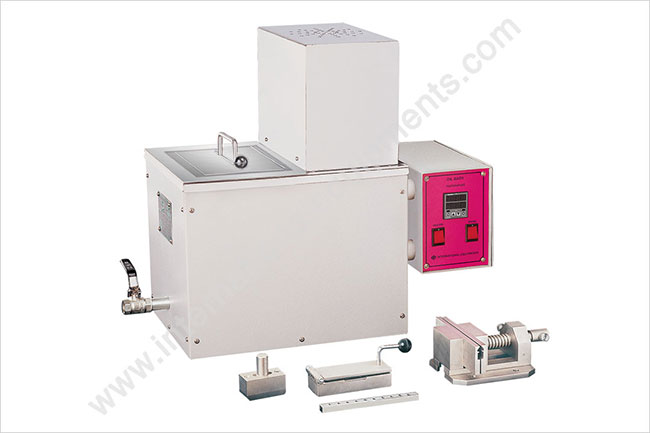
Environmental Stress Cracking Resistance (ESCR) Apparatus for PE evaluation per ASTM D1693 / ISO 22088 (bent-strip, Igepal method).
International Equipments (Mumbai, est. 1971) is an ISO 9001-certified Indian manufacturer and CE-marked exporter of ESCR Apparatus to Argentina. Environmental Stress Cracking Resistance (ESCR) Apparatus for PE evaluation per ASTM D1693 / ISO 22088 (bent-strip, Igepal method). Buyers in Argentina receive units via Buenos Aires port on CIF Incoterms with quick delivery, backed by NABL-traceable calibration and operator training.
| Parameter | Specification |
|---|---|
| Test Standard | ASTM D 1693 — Standard Test Method for Environmental Stress-Cracking of Ethylene Plastics |
| Test Method | Bent-Strip Method |
| Temperature Range | Ambient to 200°C |
| Number of Stations | Six (6) — for parallel testing of six specimens, as required for F50 calculation |
| Inner Bath Material | S.S. (Stainless Steel) — chemical resistant to stress-cracking agents |
| Outer Body Material | M.S. (Mild Steel) |
| Paint Finish | Powder coated |
| Power Supply | 230 Volts, 50 Hz, single phase |
| Cutting Die | 1 No. Cuts plastic strips to ASTM D 1693 standard specimen dimensions. |
| Nicking Jig | 1 No. Applies the controlled longitudinal notch on each specimen, ensuring uniform stress concentration. |
| Bending cum Transfer Tool | 1 No. Bends the notched strip into the U-shape and transfers it cleanly into the specimen holder without damage. |
| Aluminium Foil | 1 No. Used as the standard barrier/separator material per ASTM D 1693 procedure. |
* Other specifications and capacities can be supplied as per customer's requirement.
We offer one calibration visit per year, which is sufficient to maintain the accuracy and performance of the equipment. The calibration visit is provided after completion of the initial 1-year warranty period.
Get a free CIF Buenos Aires quotation within 24 hours - include your required capacity and target standard.
Request Free Quote or email response@internationalequipments.comInternational Equipments (Mumbai, established 1971) manufactures and exports ESCR Apparatus to Argentina. We ship CE-marked units through Buenos Aires port on CIF Incoterms with quick delivery, IRAM, ASTM & ISO compliant.
We deliver ESCR Apparatus to all major Argentina industrial hubs including Buenos Aires, Córdoba, Rosario, Mendoza, La Plata, Mar del Plata and other cities. Buenos Aires is the standard port of entry; inland trucking covers any address nationwide.
Yes. Our ESCR Apparatus fully meets IRAM, ASTM & ISO applicable test methods for Argentina, including ASTM D1693 - Environmental stress-cracking of polyethylene, ISO 22088 - ESCR of plastics. Every unit ships with a NABL-traceable factory calibration certificate accepted by accredited laboratories in Argentina.
We offer quick delivery to Argentina. Dispatch is from Nhava Sheva (JNPT), Mumbai, with CIF Incoterms to Buenos Aires port. Request a quotation for your exact timeline.
Yes. We offer one calibration visit per year, which is sufficient to maintain the accuracy and performance of the equipment. The calibration visit is provided after completion of the initial 1-year warranty period.
Buyers in Argentina include petrochemicals (YPF, Dow, Solvay), packaging & food industry, automotive supply chain, oil & gas (Vaca Muerta).
Pricing depends on capacity and accessories. Request a formal quotation via our form for exact pricing CIF Buenos Aires on your required configuration.
Our standard operator software ships in English with full ISO/ASTM test-method templates. Localised language packs may be available on request - please specify at the time of enquiry so we can configure before dispatch.
Yes. Every unit shipped to Argentina carries CE marking and a Declaration of Conformity to EU Low Voltage Directive 2014/35/EU, EMC Directive 2014/30/EU and Machinery Directive 2006/42/EC. Clearance at Buenos Aires port is straightforward.
Our equipment ships with a 12-month manufacturer warranty on parts and workmanship. After the warranty period, one calibration visit per year is sufficient to maintain the accuracy and performance of the equipment.